Barrett graduated from 91³Ô¹Ï Law School in 1997. She joined the faculty in 2002 and remained a faculty member until her confirmation to the Supreme Court in 2020.
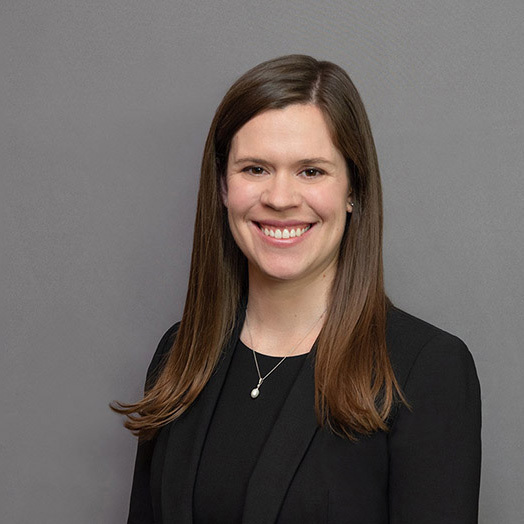
Kari Lorentson
Lorentson is a 2019 graduate of 91³Ô¹Ï Law School.
“Clerking for Justice Barrett is a dream come true,†Lorentson said. “My very first class at 91³Ô¹Ï Law School was civil procedure on a Monday morning — taught by then-Professor Barrett. I ended up taking several of her classes during law school and served as her research assistant.â€
This is Lorentson’s second clerkship with Barrett. She clerked for then-Judge Barrett on the U.S. Court of Appeals for the Seventh Circuit in 2020. However, her clerkship was cut short when Barrett was .
“I am thrilled to spend an entire year learning from Justice Barrett at the Supreme Court,†Lorentson said.
Lorentson completed her clerkship at the Seventh Circuit with Judge Michael Y. Scudder Jr. She also clerked for Judge Gerald J. Pappert, a 1988 91³Ô¹Ï Law School graduate, of the U.S. District Court for the Eastern District of Pennsylvania immediately after she graduated.
“I’m grateful to have clerked for all three judges. They are sharp thinkers, generous mentors and models of integrity,†Lorentson said. “My experiences clerking at both district and appellate courts allowed for a front-row seat in witnessing the litigation process play out from start to finish. I’m excited to spend another year absorbing as much as possible from our nation’s top legal minds.â€
As a law student, Lorentson served as executive editor of the and was a member of the Moot Court Board. She received the Col. William J. Hoynes Award, which is presented to one member of each graduating class and is 91³Ô¹Ï Law School’s highest academic honor.
Lorentson said that several professors, along with her classmates, were especially supportive in preparing her to clerk during law school.
“The professors at the Law School are not only talented in their teaching and scholarship, but they are also deeply devoted to developing the next generation of lawyers. I’m also grateful for my classmates and for the collegial and supportive environment that the Law School fosters,†Lorentson said. “My professors at 91³Ô¹Ï and the judges for whom I clerked instilled in me the importance of using my education to serve the public, and it is a privilege and honor to be able to do so at the Supreme Court.â€
, the O’Toole Professor of Constitutional Law, said, “Kari Lorentson is a superb lawyer and a person of exceptional judgment. From her early days as a law student, she had an extraordinary ability to identify the core issues in complex legal problems, and to appreciate the broader significance of those issues for the legal system as a whole. She will serve Justice Barrett and the Supreme Court very well.â€
Lorentson is currently an associate at Williams & Connolly LLP in Washington, D.C.ÌýShe earned her bachelor’s degree from American University.
Lorentson’s time at 91³Ô¹Ï made a lasting impact on her personal life as well. She met her husband, 2019 Law School graduate Matt Razzano, while in law school, and they have a young daughter, Charlotte.

Elizabeth Totzke
Totzke is a 2022 graduate of 91³Ô¹Ï Law School. After graduating, she clerked for Chief Judge Diane Sykes of the U.S. Court of Appeals for the Seventh Circuit during the 2022-23 term. Totzke is completing her second clerkship with Judge David Stras of the U.S. Court of Appeals for Eighth Circuit.
“Clerking has been such an enriching, meaningful experience. It has exposed me to new areas of the law, helped me to grow as a legal thinker and writer, and introduced me to lifelong friends. I am so grateful to both Judge Sykes and Judge Stras for giving me these opportunities and for mentoring me along the way,†Totzke said.
Reflecting on her selection to clerk for Barrett, Totzke also expressed deep admiration for the justice.
“It is the honor of a lifetime to have been selected to clerk for Justice Barrett, whom I have admired since the start of my time at 91³Ô¹Ï Law,†Totzke said. “She is a brilliant jurist, and perhaps even more importantly, she is an excellent role model with paramount integrity and a deep commitment to her faith and family. I am thrilled to have the chance to learn from her.â€
Totzke sees her clerkship with Barrett as a significant opportunity for professional and personal growth.
“It is an immense privilege to have the opportunity to assist Justice Barrett as she and the rest of the court resolve the important cases of next term. I hope to serve well,†Totzke said. “I also am looking forward to learning from Justice Barrett, the other justices, my co-clerks and the country’s best advocates — both through observation and instruction. Whether it be at oral argument, in chambers, or otherwise, I have no doubt that next year will be filled with opportunities to hone my skills as a young lawyer.â€
While at ND Law, Totzke served as the managing articles editor for the and as a student fellow in the 91³Ô¹Ï Law School .
Totzke received the Dean Joseph O’Meara Award, one of the three highest academic awards, presented annually to a member of the Law School graduating class for outstanding academic achievement.
“I feel so fortunate for my time at 91³Ô¹Ï Law School. Not only did I receive a top-notch legal education, but I was also consistently reminded of the importance of leading a virtuous and meaningful life,†Totzke said. “My professors taught by example; they are as kind and generous as they are accomplished. I am so grateful for their mentorship and guidance.â€
associate dean for external engagement and the John P. Murphy Foundation Professor of Law, said, “Elizabeth was an exceptional student and a leader among her peers. I had the privilege of working with her on a Supreme Court amicus brief in an important religious liberty case, as well as co-authoring an op-ed with her about the case, and her contributions were outstanding. The opportunity to form young lawyers like Elizabeth, who will go on to do great things, is an immense privilege. I know that she’ll make 91³Ô¹Ï proud.â€
Totzke received her undergraduate degree from St. Norbert College. Her husband, Hunter Van Asten, is also a 2022 ND Law graduate.
Two members of 91³Ô¹Ï Law School’s faculty will join Lorentson and Totzke as clerks for the October 2024 term.
Professor of Law Ìýwill clerk for Justice Neil Gorsuch, and Associate Professor of Law will clerk for Justice Brett Kavanaugh.
Lorentson and Totzke will be the fifth and sixth graduates of 91³Ô¹Ï Law School to clerk at the Supreme Court since the 2019-20 term.
91³Ô¹Ï Law School has 14 former Supreme Court clerks on its faculty, which amounts to more than one-third of the Law School’s tenured and tenure-track faculty members.
In addition, the Law School is ranked in placing graduates in federal clerkships, which are typically considered a stepping stone to clerking at the Supreme Court.
Originally published by at on May 20.
]]>The new clinic will draw from 50 years of unique international human rights pedagogy and theory of jurisprudence at 91³Ô¹Ï, which is already being applied by 91³Ô¹Ï alumni to defend human rights across the world.
The clinic will represent cases at institutions such as the International Court of Justice, Inter-American Court of Human Rights, International Criminal Court and the U.N. Human Rights Treaty Bodies. It will also undertake research and advocacy projects in collaboration with the Office of the U.N. High Commissioner for Human Rights. In addition, the clinic will address cases challenging authoritarianism in the Global South, advocating for individuals who may not typically be represented by other human rights clinics.
“The creation of this new Global Human Rights Clinic is a testament to our unwavering commitment to make a lasting impact. The clinic will actively pursue justice under international law and hold perpetrators accountable, while providing crucial support to those striving for justice in their countries,†said , the Joseph A. Matson Dean and Professor of Law. “As the oldest Catholic law school in the United States, this aligns seamlessly with our mission to train advocates devoted to defending and advancing human rights globally, to champion justice worldwide and to be a force for good.â€
That mission builds upon the work ofÌý, the founding faculty director of the clinic. Currently serving as faculty director of the LL.M. Program in International Human Rights Law and professor of law and global affairs, Desierto has made significant contributions since her arrival at 91³Ô¹Ï in 2021. She revamped the human rights program curriculum, aligning human rights theory and practice with the Law School’s natural law pedagogy; expanded and deepened course offerings in international human rights law; and designed a Graduate Seminar taught by . This seminar features high-level speakers from 91³Ô¹Ï Law’s own alumni in the field, alongside international law and human rights academic experts.
Desierto recently joined the Law School delegation to that honored the African roots of 91³Ô¹Ï’s Human Rights Program. Delegation members also recognized 50 years of the program’s global contributions through its alumni and celebrated the 75th anniversary of the Universal Declaration on Human Rights. While there, they built partnerships with leading academic institutions, connected with 91³Ô¹Ï’s human rights LL.M. alumni including South African Constitutional Court Justice Mbuyiseli Madlanga, and concluded with a panel honoring the eminent work of Justice Richard Goldstone at the South African Constitutional Court.
With more than 20 years of experience in international human rights practice, international arbitration and international litigation, Desierto recognized the evolving challenges faced by human rights lawyers in the contemporary world, making the continuity and expansion of the human rights program crucial.
She said, “Growing 15 to 20 international human rights lawyers from all over the world itself creates a multiplier effect as they serve innumerable individuals and groups for the rest of their lives. We equip them to make a lifelong difference in their respective countries. That is our true mandate and mission.â€
A board of advisers will provide input to Cole, Desierto and Miller. The board includes , , , ,Ìý, Ìý²¹²Ô»å .
The clinic will offer its courses starting spring 2024, with two-credit courses in the spring semesters and four-credit courses in the fall semesters.Ìý
In fall 2024, the clinic will formally launch its inaugural ND Law Global Human Rights Conference, showcasing 91³Ô¹Ï Law School’s distinctive pedagogy and practice of natural law, jurisprudence and international human rights law. The conference will platform 91³Ô¹Ï Law School’s ongoing engagement with international law and human rights experts from around the world.
As part of the ongoing integration of the clinic into the Law School community, it will host a separate 91³Ô¹Ï Law School Global Human Rights Lecture Series. This series will regularly feature distinguished international law and human rights judges, experts, academics, diplomats and practitioners.
To learn more, visit .
Originally published by at on Nov. 16.
]]>
91³Ô¹Ï Law School’s has been awarded a $3 million grant from Mexico’s Ministry of Foreign Affairs to administer a program for the defense of Mexican nationals in criminal matters in the United States. This grant is the largest ever received by a 91³Ô¹Ï Law School clinic, and it will greatly enhance the Exoneration Justice Clinic’s ability to support clients and provide valuable learning opportunities for students.
The Exoneration Justice Clinic was selected for the award following a national search of wrongful-conviction clinics. The award will establish the Program for the Defense of Mexican Nationals in Criminal Matters, or PDM.
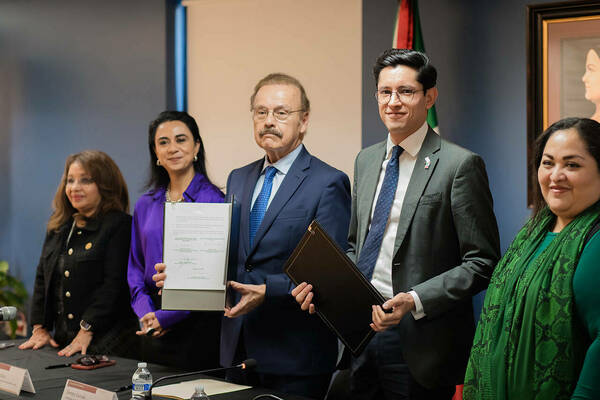
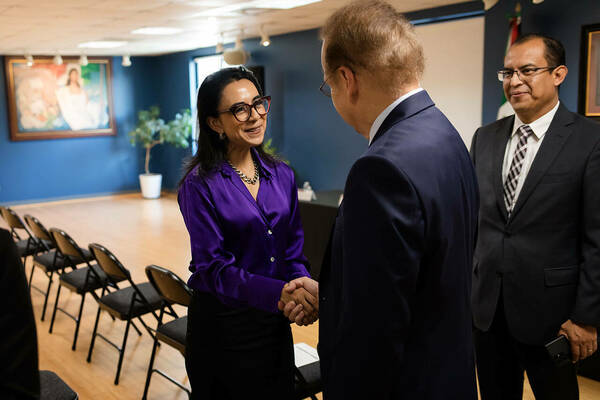
Vanessa Calva Ruiz, director general of consular protection and strategic planning; Ambassador Reyna Torres Mendivil, general consul of Mexico in Chicago; and Professor , founder and faculty director of the Exoneration Justice Clinic, signed a letter of intent at a formal ceremony on Saturday (Sept. 30) at the Mexican Consulate Office in Chicago.
Esteban Moctezuma, Mexican ambassador to the United States; Roberto Velasco Ãlvarez, chief officer for the North America Unit; Elvia Yolanda MartÃnez CosÃo, member of the Mexican Chamber of Deputies; and Jesús Seade, undersecretary for North America, also participated in the announcement.
, the Joseph A. Matson Dean of 91³Ô¹Ï Law School, said, “We are honored to receive this grant for the Exoneration Justice Clinic. It speaks to our commitment to justice and recognizes the hard work and dedication of the EJC’s faculty, staff and students. With this grant, we will expand our ability to assist individuals who have suffered wrongful convictions.â€
At the announcement ceremony, Gurulé said, “The Exoneration Justice Clinic will be working in close collaboration with the 53 Mexican Consulate offices across the country to overturn the wrongful convictions of Mexican nationals in the United States. At the same time, the PDM will provide 91³Ô¹Ï law students an invaluable opportunity to participate in litigating wrongful conviction cases in the pursuit of justice.â€
Gurulé said that wrongful convictions are of great concern in the U.S., and that Mexican nationals are particularly vulnerable. They often do not speak English and do not understand the criminal justice system and their constitutional rights. This can lead to them being pressured or coerced into making false confessions or other incriminating statements.
The Mexican government recognized this problem and sought an innocence clinic to provide legal representation to Mexican nationals who have been wrongfully convicted in the U.S.
This three-year pilot program will consist of two components. First, the Exoneration Justice Clinic will review claims of actual innocence. These cases will be referred from Mexican consulate offices throughout the U.S. They will first go through an initial screening process and then will be sent to the Exoneration Justice Clinic to evaluate the case for legal representation.
The second component of the project will include pre-trial legal assistance. This will provide a new opportunity for 91³Ô¹Ï law students to assist in pretrial proceedings, plea bargaining and trial litigation of serious felony cases under a licensed attorney.
“If you can do a thorough investigation upfront, you can prevent people from being wrongfully convicted in the first place,†Gurulé said. “This is a very exciting new dimension of the work that the Exoneration Justice Clinic is able to do.â€
The grant funding will also help increase the size of the Exoneration Justice Clinic. Expansion plans include hiring two staff lawyers — one to work on post-conviction cases and one to work on pre-trial cases — along with an investigator and a legal assistant.
“These resources will allow us to double the capacity of the EJC and make a very significant impact both in preventing and overturning wrongful convictions,†Gurulé said.
The Exoneration Justice Clinic currently works on innocence cases primarily in Indiana. With the grant the clinic will expand its reach across the country. It plans to retain local, private counsel in the cities where the cases will be tried. Clinic staff lawyers and law students will work together as co-counsel on these cases.
One of the most beneficial aspects of this grant to the Law School is that it will significantly increase the number of students who will receive real-world lawyering experience. More students will have the opportunity to represent clients who were wrongfully convicted or who are at risk of being wrongfully convicted.
“This grant will further provide our students with an opportunity to make a positive impact on reforming the criminal justice system and correcting the miscarriage of justice,†Gurulé said. “This is very exciting and is consistent with 91³Ô¹Ï’s mission to be a force for good.â€
The Exoneration Justice Clinic, which launched in fall 2020, is committed to investigating, litigating and overturning wrongful convictions. The clinic provides students with real-world opportunities to represent clients who have been wrongfully convicted.
In July 2021, the clinic marked its first exoneration when a judge approved the Elkhart County prosecutor’s motion to dismiss the murder charge againstÌý.
Read more atÌý.
Originally published by at on Oct. 2.
]]>
U.S. Supreme Court Justice Elena Kagan visited the University of 91³Ô¹Ï on Friday (Sept. 22).
Kagan spent the morning co-teaching a criminal law class for first-year 91³Ô¹Ï Law School students and meeting with Law School faculty, and later joinedÌý, the Joseph A. Matson Dean of the Law School, for a livestreamed conversation at the DeBartolo Performing Arts Center.
The talk was the first event of the 2023-24 . Since its establishment in 2005 by University President Rev. John I. Jenkins, C.S.C., the 91³Ô¹Ï Forum has invited a campus-wide dialogue about issues of importance to the University, the nation and the larger world. This year’s theme is “The Future of Democracy.â€
In his opening remarks, Father Jenkins thanked Kagan for honoring 91³Ô¹Ï with her visit and for her commitment to democratic ideals.
“Central to any strong democracy is a strong judiciary, and I can think of few people better equipped than Justice Kagan to kick off our yearlong conversation,†Father Jenkins said. “Justice Kagan has, throughout her career, devoted herself to protecting and advancing democratic principles, strengthening our judicial system, promoting civil discourse and creating opportunities for all.â€
More than 800 91³Ô¹Ï students, faculty, staff and alumni attended the event, while hundreds more watched online. Kagan and Cole’s candid conversation covered a broad range of topics, including the justice’s approach to writing, whether the court should have taken on the Biden administration’s student loan debt relief program, how her Jewish faith informs her role as a justice, whether the Supreme Court should adopt a code of ethics, and her stance on originalism and the role of precedent in the courts.
The conversation began with a discussion of Kagan’s path to the Supreme Court, which included many years in academia, first as a professor at the University of Chicago Law School and Harvard Law School, and later as the first woman to serve as dean of Harvard Law School.
Drawing on her experience as a professor, Kagan said her teaching experience informs her opinion writing and her efforts to make the judicial process easier to understand.
“When I write my opinions I try hard to figure out how it is that I’m going to explain things to people,†she said. “I want to present ideas in a way that they are comprehensible to people. This is [a] democracy, and people in a democracy should be able to understand how our institutions of government work including the courts.â€
Cole asked Kagan about her dissent in several recent cases, includingÌýRucho v. Common Cause, a 2019 case concerning partisan gerrymandering, which she described as one of the most important dissents she has ever written.
“One place where the court has the most responsibility is to actually protect the mechanisms of democracy itself,†she said. “If the democratic system is structured in a fair way, if everybody’s vote is counted and is relatively equal to every other person’s vote, then you let the democratic process work and whatever outcomes it produces. If the rules are skewed from the outset … then the results are going to be skewed. The one place where the court has a role is to protect the institution of representative government.â€
Cole also invited Kagan to discuss her views on originalism. She described a framework where, in her view, constitutional meaning evolves and develops over time, and she believes this is consistent with the framers’ intent.
“These people were speaking for the ages, and they knew it,†Kagan said. “If there was anybody who understood how the world changes, it was those people. How societies change, how governments change, how people change. They had brought on a revolution. They wanted the constitution to be fit to govern a people as that people lived over time.â€
As the conversation continued, Kagan stressed that this philosophy does not mean courts are free to do what they want.
“Constraint, discipline and incrementalism are really important judicial values,†Kagan said.
She also emphasized adherence to precedent as a key to stability in legal development and to prevent the court from appearing ideologically driven.
“People have no right to expect that they are going to agree with all the decisions that courts make,†she said. “But people do want courts — and have a right to expect — that courts act like courts, and that they don’t look like other political actors.â€
Cole also asked Kagan how universities and law schools can create an environment where people feel free to speak their minds in the midst of increasing polarization.
“This nation cannot work or do the things it needs to do unless people can talk with each other, and really try to understand each other and learn from each other,†Kagan said. “This will not happen unless people work together across various disagreements, as profound as they may be.â€
Kagan said this is especially important in educational institutions focused on learning, engagement and free exchange of ideas.
After the event, second-year law student Mackenzie Krage said, “Having Justice Kagan grace our law school with her wisdom and experience was truly a remarkable privilege. The conversation she shared with Dean Cole served as a reminder that the pursuit of justice is not just a concept we study, but an important force in our democracy to which courts can protect its future.â€
Cole said the visit provided students an invaluable glimpse into the workings of the highest court and served as a reminder that 91³Ô¹Ï is a welcoming place for free and respectful intellectual exchange.
“We were honored to host Justice Kagan at 91³Ô¹Ï Law School,†Cole said. “I am happy that so many of our students had the opportunity to hear from and engage with her during her time with us.â€
]]>
U.S. Supreme Court Associate Justice Elena Kagan will visit the University of 91³Ô¹Ï on Sept. 22 (Friday).
Justice Kagan will be the first speaker for the 2023-24 . She will participate in a conversation with , the Joseph A. Matson Dean of 91³Ô¹Ï Law School, at 2:30 p.m. in the Leighton Concert Hall of the DeBartolo Performing Arts Center.
The 91³Ô¹Ï Forum, hosted by University President , has been held annually since 2005, with events each year focused on a central theme of particular importance to the University, the nation and the larger world. This year’s forum theme is “The Future of Democracy.â€
“We are honored to host Justice Kagan at 91³Ô¹Ï, and to hear her reflections on the unique role of the judiciary in our democracy,†Father Jenkins said. “I hope this important conversation will encourage each of us to reflect more deeply on the privileges and responsibilities of citizenship and how we can contribute to the flourishing of our democracy.â€
The talk will be free, but ticketed, and open to members of the 91³Ô¹Ï campus community. Tickets will be available on a first-come, first-served basis at the DeBartolo Performing Arts Center Ticket Office one hour prior to the event. Attendees will need to show their 91³Ô¹Ï identification card at the door.
A livestream of the conversation will be available to watch on 91³Ô¹Ï Law School’s The event will also be open for media coverage.
In addition, Justice Kagan will meet with 91³Ô¹Ï Law School students and faculty during her visit.
“We are deeply honored to have Justice Elena Kagan visit 91³Ô¹Ï Law School,†Cole said. “Our students, faculty and the entire 91³Ô¹Ï community will benefit from getting to know one of our nation’s greatest jurists.â€
Justice Kagan was nominated to the Supreme Court by President Barack Obama on May 10, 2010, to replace retiring Justice John Paul Stevens. She was confirmed by the Senate in August 2010 and became the 112th justice and fourth woman on the court.
Prior to her Supreme Court nomination, she served as the solicitor general of the United States, a position that Obama nominated her for in 2009.
Between 2003 and 2009, she served as the dean of Harvard Law School. She also served for four years in President Bill Clinton’s administration as associate counsel to the president and deputy assistant to the president for domestic policy.
A native of New York, Justice Kagan is a graduate of Princeton University. She received a master’s degree in philosophy from the University of Oxford and earned her juris doctor from Harvard Law School.
Justice Kagan will be the seventh of the nine sitting justices on the Supreme Court to visit 91³Ô¹Ï in recent years. Prior justices visiting campus include Justice Samuel Alito, Justice Amy Coney Barrett, Justice Brett Kavanaugh, Chief Justice John Roberts, Justice Sonia Sotomayor and Justice Clarence Thomas. In addition, the late Justice Ruth Bader Ginsburg visited 91³Ô¹Ï while serving on the court.
Learn more about the 2023-24 91³Ô¹Ï Forum at .
]]>She took advantage of opportunities like the program, where she spent the spring 2022 semester in an externship with the U.S. Agency for International Development. She also did a yearlong judicial externship with the U.S. District Court for the Northern District of Indiana, was executive articles editor for the Ìý²¹²Ô»å served as vice president of the Military and Veteran Law Society.
After Hildebrand graduates from 91³Ô¹Ï Law School this weekend, she will realize her goal by returning to Washington to work for the U.S. Department of Justice as part of the prestigious DOJ Honors Program.
And, thanks to 91³Ô¹Ï Law School’s , Hildebrand won’t have to worry about making payments on her students loans.
LRAP is one of the important ways that 91³Ô¹Ï Law School fulfills its Catholic mission to educate a “different kind of lawyer†who uses his or her education for the public good. The program supports J.D. graduates who are beginning legal careers in the nonprofit sector, government, policy advocacy, human rights and other fields where lawyers make valuable contributions but are often paid lower salaries.
Earlier this spring, the Law School announced to LRAP that will enable the program to support even more J.D. graduates who pursue their callings in public interest law and government. One of the significant changes is that LRAP will now cover graduates with salaries as high as $100,000, with upward adjustments for graduates with children. That is a 40 percent increase from the previous salary cap of $70,000.
In the class of 2023, LRAP will support new graduates who are starting jobs with nonprofit organizations, the federal government, prosecuting attorney offices, and federal, state and specialized courts.
“As a student who has been focused on public service throughout law school, thinking about the burden of student loan debt and the opportunity for higher incomes in other career paths can be discouraging,†said Hildebrand. “91³Ô¹Ï Law School has given us the opportunity to pursue a career in public service without having to worry about that burden.â€
Under the previous LRAP structure, Hildebrand would not have qualified for the program because her DOJ salary is more than $70,000. She was excited to learn in March that 91³Ô¹Ï Law School was improving LRAP to cover more J.D. graduates — including her.
“I would have been making just enough to disqualify myself from LRAP, but not enough to be able to balance the cost of living in Washington, D.C., with paying off my student loans,†Hildebrand said. “The improvements are immensely beneficial for many students in a similar situation.â€
Mike Cassidy, another member of 91³Ô¹Ï Law School’s class of 2023, will begin his career as a prosecuting attorney with the Tarrant County Criminal District Attorney’s Office in Fort Worth, Texas.
While networking during the summer after his first year of law school, Cassidy realized that he wanted to find an area of the law that he found very fulfilling. He was working as an intern for Judge Peter Bogaard of the New Jersey Superior Court during that summer. He said he spoke to a couple of prosecutors and knew that was the career path he wanted to pursue.
“Their fidelity to the pursuit of justice was admirable,†Cassidy said, “and I saw myself being passionate about the pursuit of justice throughout my career.â€
Knowing he had access to LRAP assistance was an important factor in Cassidy’s decision-making process. He said the increase in the salary cap will provide flexibility to him as he moves throughout his career.
“I want to be able to be a career prosecutor, and not have to worry about having to change my job to make ends meet,†said Cassidy. “Thank you so much to the benefactors who have made this program possible. You’ve enabled me to pursue a career path without having to worry about my loans.â€
Michael Klein, who will also graduate this weekend with the class of 2023, will commission this summer to the U.S. Navy Judge Advocate General’s Corps. He will be responsible for legal assistance to sailors, legal advising to naval commands, and military justice.
“I chose this career path because I value service,†Klein said. “My skills are suited to serve other sailors who have committed their lives to the defense of our nation. I cannot think of a more worthy cause within the secular realm.â€
Klein did not expect to qualify for LRAP benefits until the increase in the salary cap was announced earlier this spring.
“The increase will allow me to remain a public servant longer, perhaps for a lifetime, because it will make personal goals like homeownership much more attainable,†said Klein. “I cannot think of a better place to earn a legal education than 91³Ô¹Ï Law School. The ability and empowerment to choose any career after law school is unmatched.â€
Hildebrand also emphasized that using her legal education to serve is the most fulfilling opportunity.
“I am beyond thankful to have been able to attend 91³Ô¹Ï Law School and am grateful for the school’s effort to continue supporting students even after graduation,†she said.
Learn more about 91³Ô¹Ï Law School’s Loan Repayment Assistance Program at .
Originally published by at on May 18.
]]>Beatriz was a 21-year-old woman from El Salvador who sought an early abortion because she had lupus and some of her doctors advised her that pregnancy could exacerbate her health condition, and because her unborn child was anencephalic. She was prevented from terminating the pregnancy because abortion is illegal in El Salvador. The Inter-American Commission on Human Rights filed an application last year before the Inter-American Court of Human Rights arguing that the absolute ban on the elective termination of pregnancy in El Salvador violated that country’s obligations under the American Convention on Human Rights.
Carozza served on the Inter-American Commission on Human Rights from 2006 to 2010 and was the commission’s president in 2008-09. He is recognized as a leading expert in comparative constitutional, human rightsÌý²¹²Ô»å international law. He was asked by the court to testify as an expert witness about which international legal standards should be applied in the case. His 50-page written report and oral testimony addressed how the principle of human dignity is relevant in this case; the importance of the right to equal protection of all humans without regard to their development, capacities, sex or other condition; and the obligations and discretion of states under international human rights law to adopt measures to protect human life prior to birth.
In his testimony, Carozza said that international human rights law confirms without exception that the recognition and protection of the equal dignity of every human being is the cornerstone of all universal human rights and that the principle of human dignity on which all international human rights law rests consists of four essential qualities: universal, equal, inherent and inalienable.
In conclusion, Carozza urged the court “to affirm unequivocally that the duty of States is to protect equally the human rights of both women and children, born and unborn.â€
Carozza currently serves on the and is a member of the , an independent expert body created by Meta. He was previously a member of the U.S. State Department’s independent, nonpartisan advisory . Carozza founded and directs the . For over a decade he served as director of and of 91³Ô¹Ï Law School’s J.S.D. program. His scholarly books and articles in the areas of comparative constitutional law and human rights law have been published widely in four languages.
To read this full story, .
A video of Carozza’s testimony is embedded below. Watch a video of the full hearingÌý.
Ìý
Originally published by at on March 30.
]]>The ABA’s House of Delegates created 10 recommendations for residential eviction law for state, local and other governing bodies to implement.
The recommendations include establishing steps to limit the stress that eviction judgments take on families by encouraging negotiated settlements, ensuring fairness in eviction hearings, limiting evictions in cases where renters are in compliance with their lease obligations or are able to quickly resolve any non-compliance, and sealing court records in appropriate cases so that families are not prevented from renting new homes.
The Law School’s report, “Eviction Protections for Renters: Does Indiana Make the Grade?â€Ìýwas written by , clinical professor of law and associate dean for experiential programs, and , program director for the . Several students who work with the Eviction Clinic also helped with the report.
The report looks at each of the 10 ABA guidelines and then discusses how Indiana law measures up to each.
The report points out, for example, that Indiana renters may be evicted from their homes with little notice and without having violated their leases. Renters are rarely represented by attorneys and are required to defend themselves without knowledge of the law. Eviction hearings do not provide a complete opportunity for renters to present a defense. Eviction court records are not automatically sealed and the mere fact of having faced an eviction complaint may prevent a renter from passing screening for future housing.
“Roughly 800,000 Indiana households, including many of the state’s most vulnerable residents, are renters,†Jones said. “The goal of this report is to help Indiana policymakers think more comprehensively about how to ensure fairness and housing stability for those Hoosiers. This report is the first to look at Indiana’s eviction laws comprehensively and to compare them to a national standard. Indiana falls short.â€
The report was commissioned by the Indiana Justice Project as a part of the Housing Equity for Infant Health Initiative. The lead partner in this initiative is the Grassroots Maternal and Child Health Initiative, located at Indiana University, Indianapolis.
“The law students and faculty of the Clinical Law Center have represented countless renters in eviction proceedings over the years,†said Pruitt. “We see on a daily basis how the shortcomings in Indiana law disadvantage renters. It is not an abstract issue, but rather a matter of human suffering and dislocation that affects children and adults alike. There are many ways, large and small, that Indiana laws could be reformed to achieve basic fairness.â€
The report is based on many hours of student research and is informed by students’ firsthand experience representing renters in eviction court.
“Our students constantly think about how the law reflects our values and impacts the lives of their clients,†Pruitt said.
Jeanna James, a third-year law student who has represented numerous renters as a certified legal intern, added that she has seen how “the way the eviction laws work in practice magnifies the inequality between landlords and renters. Renters may be evicted for nearly any violation of their lease obligations, while landlords often violate their obligation to provide habitable homes with impunity.â€
The other 91³Ô¹Ï Law School students who worked on the report are Thomas Haracz, Brigid O’Keefe, Kate O’Laughlin, Alexa Schykerynec, Michael Snyder and Drake Stobie.
Read the full report:Ìý
Originally published by at on Feb. 14.
]]>
“Everybody can be great, because everybody can serve.â€
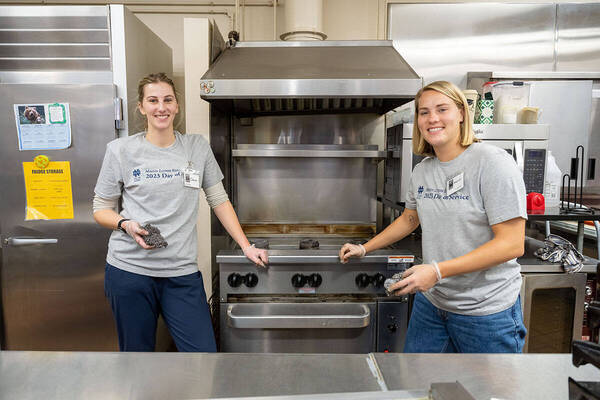
In the spirit of that call to action from Dr. Martin Luther King Jr., more than 100 students, facultyÌý²¹²Ô»å staff spent time on Jan. 16Ìýserving the greater South Bend community by volunteering for local nonprofit organizations during the Law School’s second annual Martin Luther King Jr. Day of Service.
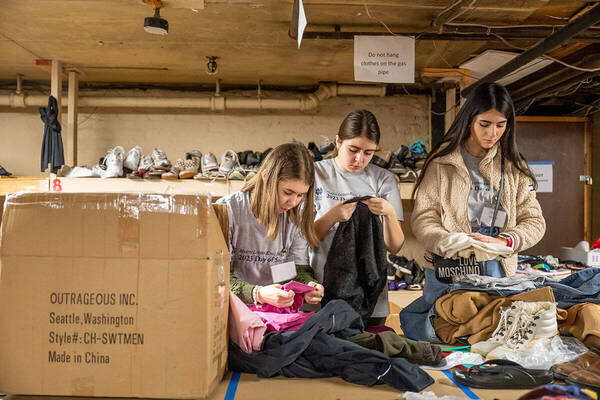
The volunteers made an immediate impact by preparing 5,000 meals, assembling 100 personal care kits, sorting 500 articles of clothing, planting 600 seedlings for future food and distributing 250 donations — and this is just a sampling.
The University of 91³Ô¹Ï announced last year that Martin Luther King Jr. Day would be a holiday to allow members of the 91³Ô¹Ï community to honor King’s legacy in their own way. The Law School started its own tradition of honoring King’s dedication to service and fight for racial justice by offering the Law School community the option to participate in a variety of service projects.
The idea for the Martin Luther King Jr. Day of Service was initiated by , the Joseph A. Matson Dean of 91³Ô¹Ï Law School.
“We started the Martin Luther King Jr. Day of Service as a way for us as a law school community to come together to give back in service to the community and in service to God,†said Cole. “As a Matthew 25 law school, Jesus commands us to feed the hungry, clothe the naked and visit the prisoners. We are trying to be good stewards of the blessings we have been given, and also use the opportunity we have to serve others, not sometime in the future, but to serve others right now.â€
Some of the service projects were completed at the Law School, while other volunteers served at off-site locations.
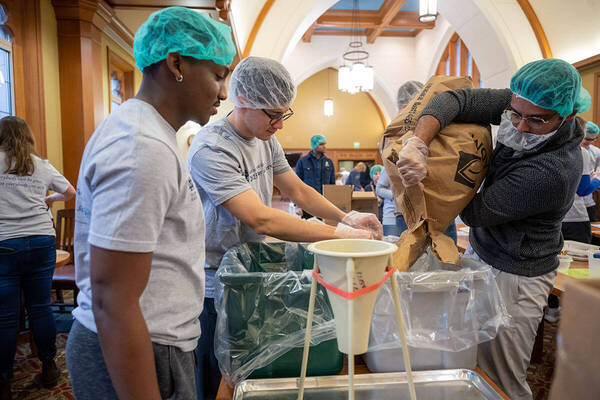
More than 30 volunteers worked together in an assembly line in Eck Commons to pack meals for Pack Away Hunger. The organization’s mission is to eliminate hunger in Indiana and around the world through nutritious food, education and service.
Kathryn Hawkins, a 2002 graduate of the University and volunteer with Pack Away Hunger, led the group of ND Law students, facultyÌý²¹²Ô»å staff.
“In northwest Indiana, nearly 100,000 individuals are food insecure, meaning they lack access to enough good, nutritious food for themselves and their families. Many people who are food insecure don’t qualify for government assistance, and must turn to food pantries,†said Hawkins. “The meals packed at this event will provide warm, healthy meals.â€
The meals, vegetable soup starters, were assembled at the Law School and delivered to the Clay Church food pantry in South Bend.
Adem Osmani, a first-year law student who helped prepare the meals, said, “I am proud that the Law School provides opportunities for law students to serve the South Bend community. It is important that we give back and understand the importance of service while we are law students and preparing to be future attorneys. Service is an excellent way of honoring the legacy of Martin Luther King Jr. and pursuing our mission of becoming a ‘different kind of lawyer.’â€
Second-year law student Owyn Ferguson also worked on the Pack Away Hunger assembly line.
“I appreciate going to a law school that acknowledges this day not simply as a holiday but as a ‘day on’ and that there is some type of obligation to use the time to serve others,†said Ferguson. “That principle threads through what the Law School encourages already — to use your gifts and opportunities for the betterment of others.â€
Ferguson also thought that it was a great opportunity to do service work alongside his peers.
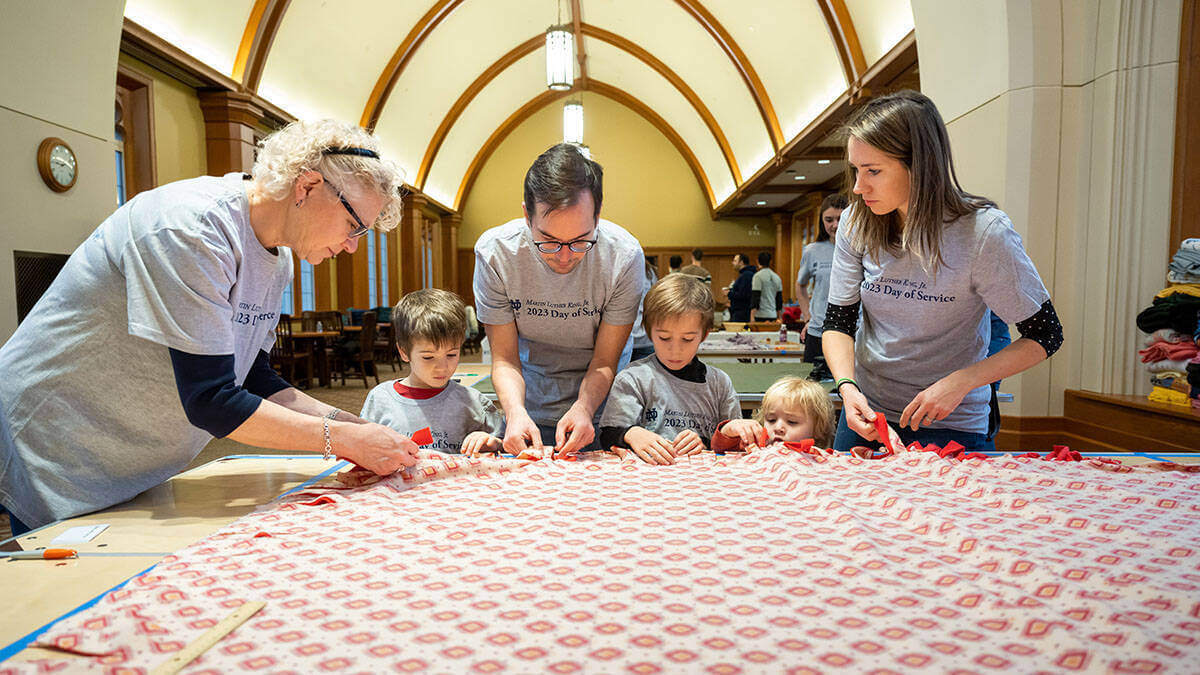
Another project at the Law School was making no-sew fleece blankets for Ronald McDonald House Charities of Michiana, Dismas House, St. Margaret’s House and the Center for the Homeless.
Third-year law student Carol Graffeo was one of the volunteers at the blanket-making station. The Ronald McDonald House was the charity her sorority supported when she was in college, so she saw that opportunity as a perfect fit.
“I thought the day of service was a great way to start off my last semester of law school with the right mindset,†said Graffeo.
Volunteers also assembled personal care kits for the residents of St. Margaret’s House, a day center for women and their children who live in economic poverty.
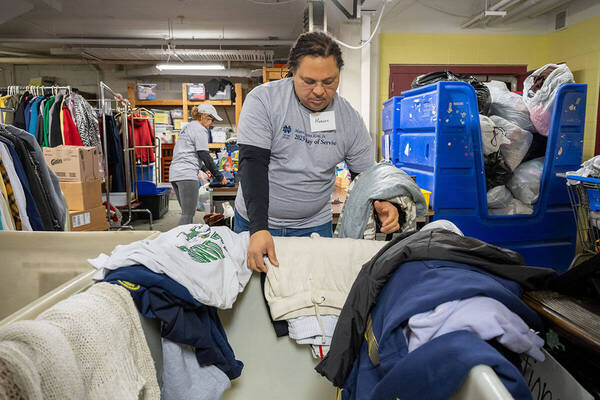
Members of the Law School community brought in hundreds of donations of sheets, pillows, blankets, towels, gloves, coats, activity books and personal care items for the Center for the Homeless, Real ServicesÌý²¹²Ô»å Dismas House. Volunteers on-site organized those donations and delivered them to the various organizations.
One of the remote sites for volunteers was St. Margaret’s House, where volunteers organized clothing that women who are part of the St. Margaret’s community can shop for free. Another team of volunteers did a deep clean of the kitchen. St. Margaret’s House feeds up to 100 women and children a day for breakfast and lunch, and provides a safe and nurturing environment for respite.
The staff at St. Margaret’s House all echoed how much dedicated volunteer work helps their mission, and how thankful they are for the volunteers who came to serve.
“Part of the reason I came to 91³Ô¹Ï was because it was founded on service and its mission of educating ‘a different kind of lawyer,’†said second-year student Claire Ramsey, who helped clean the kitchen. “This day of service is a great opportunity to expand the 91³Ô¹Ï community into the South Bend community and make sure we are carrying out the Law School’s mission off-campus as well.â€
Fifteen volunteers spent time at the Center for the Homeless working in their donation room, sorting and organizing hundreds of clothing items for children and adults.
First-year student Nick Munsen decided to volunteer at the Center for the Homeless because he believed the work there captures a major part of the teachings of King, especially of addressing inequalities.
“Racial and wealth inequality are closely tied together in our community in South Bend and across the nation. In serving the economically marginalized here, we also address a key consequence and driver of racial inequality,†said Munsen. “This kind of service reminds me that, as law students, we have been given opportunities many others have not, and must use our skills for the benefit of those most in need. Not participating in direct service poses a real risk to ourselves and to society as a whole, as we need to be consistently reminded of our mission. Service reminds me what ND Law is all about.â€
Adriana Hrytsyna, one of three exchange students this semester from Ukrainian Catholic University, also worked at the Center for the Homeless and said, “Being from Ukraine, we volunteer a lot. We have a lot of experience and this is an opportunity to share it with other cultures and show that all of us should do something good to make this world a better place for everyone.â€
Volunteers also went to Green Bridge Growers, an innovative venture that grows fresh food and provides jobs for those with autism. There they planted seedlings, reconfigured the plumbing system in the aquaponics greenhouse, and painted the stands that house plants under cultivation.
In addition, a team of volunteers did maintenance and deep cleaning at Ronald McDonald House Charities of Michiana.
The day of service was not just limited to those on the main campus. Law students studying in London with the 91³Ô¹Ï London Law Programme also participated in service projects on Monday.
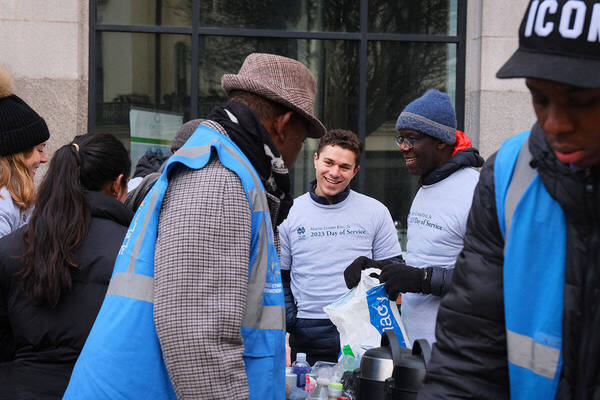
Eight students worked with Refuge Network UK. They packed meals and served lunch at an outdoor soup kitchen and handed out meal kits to homeless people, also known as “rough sleepers,†in various parts of London. Other volunteers worked with the Felix Project, a London-based food redistribution charity that connects the surplus produced by the food industry to the millions of adults and children in the United Kingdom who struggle to afford to eat every day.
The Law School faculty participated in a number of the service projects as well. Professor was among the volunteers who chaperoned children from Hope Ministries at a movie and provided them with companionship.
“My parents were active in the civil rights movement, and both attended King’s ‘I have a dream’ speechÌýin Washington, D.C. So from a very young age they taught my brother and me the equality and human dignity of each person,†said Kelly.
“Participating in the Hope Ministries service project, and witnessing so many other service projects in which a hundred of my colleagues — faculty, staffÌý²¹²Ô»å students — were able to participate from 91³Ô¹Ï Law School, was a wonderful opportunity for prayer, reflection and service,†he said.
Originally published by at on Jan. 18.
]]>Due to limited seating in the McCartan Courtroom, in-person attendance at Barrett’s speech will be open only to 91³Ô¹Ï Law School students and faculty, students in 91³Ô¹Ï’s Constitutional Studies Program and members of the media.
Barrett graduated from 91³Ô¹Ï Law School in 1997 and joined the faculty as a professor of law in 2002. She served as executive editor of the Law Review when she was a student and later served as its faculty adviser for many years.
In 2017, she was appointed as a judge on the U.S. Court of Appeals for the 7th Circuit. She remained a 91³Ô¹Ï Law School faculty member and continued to teach part-time after her judicial appointment. She was in October 2020.
“For more than two decades, 91³Ô¹Ï Law School was blessed by Justice Barrett’s brilliant scholarship, devoted teaching and thoughtful approach to legal questions,†said , the Joseph A. Matson Dean and Professor of Law at 91³Ô¹Ï Law School. “We look forward to welcoming her back to the Law School for this year’s Federal Courts Symposium.â€
The 2022 Federal Courts Symposium, titled “The Nature of the Federal Equity Power,†will focus on that which remains unsettled about the qualitative nature of the federal equity power, its relationship vis-à -vis law and its proper scope within the broader constitutional system of law. The symposium will feature several panels of prominent legal scholars who will address these complex questions from historical, judicial and academic perspectives.Ìý
The papers from the symposium will be published in the , one of Law Review’s five annual issues and dedicated specifically to topics in the area of federal courts, practice and procedure.
“Our current volume of the 91³Ô¹Ï Law Review marks the 25th anniversary of Justice Barrett’s tenure as executive editor of the journal. In that role, Justice Barrett laid the foundations for the Federal Courts issue. We are honored and grateful that Justice Barrett will return to 91³Ô¹Ï and serve as the keynote speaker of the Federal Courts issue’s symposium,†said third-year law student Aiste Zalepuga, editor-in-chief of the 91³Ô¹Ï Law Review.
John P. Murphy Foundation Professor of Law serves as the 91³Ô¹Ï Law Review’s faculty adviser.
“We are honored that Justice Barrett will participate in the symposium. Not only did she play an important role in establishing the Federal Courts Symposium, but she served for many years as adviser to the Law Review. We are delighted to welcome her home,†Garnett said.
The symposium will be Barrett’s second visit to 91³Ô¹Ï Law School during the 2021-22 academic year. to teach an intensive, one-week course on statutory interpretation to third-year law students.
]]>, the John P. MurphyÌýFoundationÌýProfessor of Law, was cited by Associate Justice Samuel Alito’s opinion for the court in Tennessee Wine and Spirits Retailers Association v. Thomas. Professors and were cited by Associate Justice Neil Gorsuch in a concurring opinion in Kisor v. Wilkie.
Tennessee Wine and Spirits Retailers Association dealt with the constitutionality of residency requirements for retail liquor sales. In his opinion, Alito cited Cushman’s work, "," to demonstrate the important role the Commerce Clause has played in the economic history of the country.
The court in Kisor reconsidered the so-called Auer doctrine of administrative law, which governs administrative agencies’ interpretations of their own regulations. In his concurring opinion, Gorsuch cited Pojanowski’s work in "," which arguesÌýthat Auer rests on a misunderstanding of its originating case, the 1945 decision Bowles v. Seminole Rock, and that Seminole Rock implies a less-deferential standard of ruleÌý²¹²Ô»å Congress likely codified this less-deferential approach in legislation on judicial review of agency action.
Kozel, who also serves as 91³Ô¹Ï Law School’s associate dean for faculty development and directs theÌý,Ìýwas also cited by Gorsuch. He cited Kozel’s article, "," which discusses the precedential effect of judicial decisions that set out wide-ranging principles of interpretation for future cases.
Originally published by at on June 28.
]]>