tag:news.nd.edu,2005:/news/authors/heather-asiala tag:news.nd.edu,2005:/latest 91Թ | 91Թ | News 2022-05-03T13:35:00-04:00 91Թ gathers and disseminates information that enhances understanding of the University’s academic and research mission and its accomplishments as a Catholic institute of higher learning. tag:news.nd.edu,2005:News/145285 2022-05-03T13:35:00-04:00 2022-05-03T13:35:54-04:00 Pulte Institute launches Central America Research Alliance The — part of the at the University of 91Թ — has launched the (CARA): a network focused on delivering evidence-based advocacy by amplifying the work of Central American scholars and practitioners.

Co-directed by the Pulte Institute’s and , and in partnership with researchers at more than a dozen Central American , CARA conducts to inform development policy and practice in migration, citizen security, democracy and governance, and human rights in El Salvador, Honduras, Guatemala, Belize, Costa Rica, Panama and Nicaragua.

“Our goal with CARA is to learn from the research and realities of those that experience the region every day in order to put these development issues into context,” said Rivero, a senior research associate with more than 20 years of experience conducting research and evaluating social programs in Central America. “At CARA, we ask: How does a focus on integral human development and dignity help people flourish? How can 91Թ — with its global expertise, world-class research resources and access to American stakeholders — create synergies that create meaningful change in these countries? By making these issues more accessible we hope we can not only inform, but also spur action.”

Central American Dialogues event in 2019

In April, the U.S. Department of State awarded CARA a $2 million grant to evaluate the Gang Resistance Education and Training (GREAT) program in El Salvador, Honduras, Panama and Costa Rica. Part of the U.S. government’s $411 million investment in citizen security and gang reduction in the region over the past decade, GREAT is implemented by preventive police officers in schools to educate them on the risks associated with delinquency and to develop channels of communication with youth. Together with Florida International University and the University of Central America, CARA will work closely with country schools, parents, youth and police to evaluate the effectiveness of the GREAT program and make recommendations for future implementation of the program in the region.

Hare, a senior researcher who has lived, studied and worked in the region over the past 20 years and wrote the book,” is leading the GREAT project team alongside Rivero and , a Pulte Institute faculty fellow and associate professor of psychology and peace studies.

“For decades, Central American countries have grappled with issues of crime and youth violence. Efforts to reduce gang membership range from individual interruption interventions and family therapy, to community strengthening, police reform and other policy initiatives,” said Hare. “This is the first time the GREAT program will be evaluated outside of the U.S., and the results of the study are likely to have major implications for how the U.S. supports gang and violence prevention in the region going forward.”

This award and support to academic endeavors is particularly important as the Biden administration works to determine the best way to invest to the region, and as and around free speech devastate El Salvador.

El Salvador is not the only country in the region facing increasing restrictions to democratic freedom. In Nicaragua, academia is being threatened as the government in an effort to quell voices critical of President Daniel Ortega. In a recent , Hare and Rivero wrote: “Far from being just another step toward eliminating free debate, the dismantling of universities is a near-fatal blow to democracy. … We must not be silent witnesses of these historical moves away from free societies.”

In addition to violence prevention and democracy, CARA will focus on initiatives that explore the root causes of migration. Hare and Rivero have led several and events that explore migration from the region, including a focusing on the realities beyond the border.

“Numerous factors influence migration: violence at home and in the community, political unrest and access to quality employment, to name a few. Restricting civil liberties will not make these countries any safer, and the number of those who do not see hope in the future of their country will undoubtedly increase,” said Hare.

CARA’s recent success is built on a foundation of strong partnerships. The network’s 16 partners include respected universities, research and advocacy groups and influential government representatives.

, a Master of Global Affairs student at the Keough School and former journalist from El Salvador, has been working with the Pulte Institute for several years to build partnerships in Central America. Today, she works closely with CARA’s partners to grow a culture of evidence that addresses the systemic, cross-sectoral issues contributing to development challenges in the region.

“The topics CARA is studying are very real issues our partners are experiencing on a regular basis,” said Villatoro. “We have a unique opportunity to elevate the voices of their communities so they are heard internationally. By doing this we hope we can begin to change minds and hearts in a way that creates tangible impact.”

The CARA team will begin work on the GREAT program in early summer, and plans to host an in-person meeting with regional partners in Central America this fall. To learn more about the work of CARA, visit .

]]>
Heather Asiala
tag:news.nd.edu,2005:News/140241 2021-09-20T13:00:00-04:00 2021-09-20T13:30:08-04:00 New ThinkND series to explore the realities of migration from Central America The and the , both part of the University of 91Թ’s, will embark on a virtual teaching series examining the realities of migration from Central America. “” is a three-part series hosted on the platform; sessions will be held on Wednesdays at 1 p.m. EDT beginning Sept. 29 and ending Oct. 13. 

Migration from Central America to the U.S. continues to make headlines and drive policy discussions. This series will use research-based evidence to go beyond the typical narrative and discuss the issues behind the root causes of migration from the region. Researchers, practitioners and policymakers from the U.S. and Central America will come together in conversation to explore how we can promote safe paths to prosperity and dignity at home and abroad.  

The series will be led by , senior researcher with the Pulte Institute and an expert in democracy, rule of law and human rights programming in Central America. Hare will facilitate discussion among faculty members, researchers, practitioners and policymakers to consider questions such as:

  • What are the true drivers of migration from Central America, and how do issues such as climate change, violence and education play a role? 
  • How can civil society, governments, academia and the private sector work together to improve regional development in Central America?
  • What is and should the U.S. government be doing in Central America, and how has that strategy evolved over the past few years? 
  • What is the response of the Church to current migration issues?
  • What can we, as U.S. citizens, do to help make migration a more dignified process?

The series is made possible through the Pulte Institute’s new (CARA), a partnership network that focuses on evidence-based advocacy in the region.  

“Our goal with this series — and more broadly with CARA — is to use evidence to put the issue of migration and development in the region into context, and to give special priority to marginalized voices from Central America,” said Hare. “If we can make the issues surrounding migration more accessible, then we can spur action for meaningful change. ThinkND and the Kellogg Institute are excellent partners to help us achieve this goal.” 

The Beyond the Border series will include a combination of short faculty presentations, guest panel insight and lively group discussion via weekly interactive Zoom sessions. This is the second series as part of the larger “Conversations on Poverty and Inequality” program from the Pulte Institute, which aims to create open dialogue on topics relevant to alleviating global poverty and inequality. 

The program is free and open to all and is hosted exclusively on ThinkND, 91Թ’s open, online learning community. for more information and to register

Originally published by Heather Asiala at on September 20, 2021.

]]>
Heather Asiala
tag:news.nd.edu,2005:News/130440 2020-10-29T15:00:00-04:00 2020-10-29T15:42:30-04:00 91Թ innovates at home and abroad to further Paraguayan program despite pandemic restrictions On March 1, a team of researchers from the University of 91Թ’s part of the and (ID) set out to begin work on the (ROLCI) program. Funded by and implemented by ID, ROLCI is designed to strengthen the role of higher education institutions in Paraguay in promoting the culture of legality and respect for the state of law. A subaward would allow 91Թ to deliver a series of in-person training and research activities to meet this goal.

Two weeks later, the COVID-19 pandemic hit the Midwest in full force: 91Թ sent staff and students home, restricted travel and canceled all in-person events for the foreseeable future. The Pulte Institute and ID found themselves rapidly transitioning their work plans to implement a completely virtual program of activity across international borders.

Paraguay Workshop
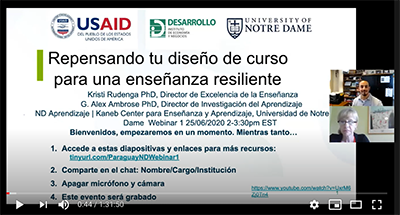
Alex Ambrose, drector of learning and research at the Kaneb Center,
delivers a workshop session with translator Jennifer Zachman.

The original scope of work included a legal assessment of seven Paraguayan higher education institutions, targeted research focused on the Paraguayan judicial system and a resource methodology workshop series. The realities of the COVID-19 pandemic soon made it clear that the intended travel for key informant interviews and delivery of an in-person workshop series would be impossible. By early April the planning had shifted, and the team decided to use video interviews to gather research data and the workshop series, intended as a five-day in-person workshop in August, was redeveloped as a multi-week online training series. This allowed the content to be delivered in smaller segments through both synchronous and asynchronous methods.

“The necessity of rapidly transitioning our work due to the pandemic actually created several opportunities within the scope of this project. For starters, we were able to reallocate funding previously held for travel to develop more Year 1 activities that would meet the needs of our Paraguayan partners,” said , program manager within the Pulte Institute’s Entrepreneurship and Education Division. “Moving to the virtual environment forced us all to be creative. Our Paraguayan partners realized the immense opportunity that online learning presented, as many of their students work part-time or live off campus and ended up preferring online education. Working with ID, we were able to provide these partners with training to bring online teaching best practices to their students, both during the pandemic and after.”   

ID and the Pulte Institute quickly began discussions and outlined a plan to provide an additional designed to prepare Paraguayan educators to use best practices for online teaching. Trainers and experts from and OIT’s Teaching and Learning Technologies Group were commissioned to create, translate, facilitate and record an interactive webinar series using state-of-the-art technologies and online pedagogies during and after COVID-19. More than 230 faculty and administrators from several Paraguayan institutions including universities such as the National University of Asunción and public ministry training centers like the International Center for Judicial Studies of the Supreme Court of Justice attended and participated in the six-part live, dual-language series. 

Despite the pandemic drastically changing the trajectory of the project, ROLCI Program Director from Instituto Desarrollo José Tomás Sánchez found that the results achieved were impressive. “In total, the expected number of participants in our training courses increased by at least four times,” said Sánchez. “Additionally, we have been able to double the number of research projects we conduct and the number of interactions between 91Թ academics and institutions multiplied. We did several workshops, meetings, forums and training courses. All of this was possible thanks to the incredible adaptability of the 91Թ team and our partners in Paraguay.”

In addition to the Online Teaching and Technologies Webinar Series, the team was also able to deliver a comprehensive analysis of the barriers that Paraguayans face in entering the legal profession, as well as four research proposals for Year 2 activities. 

“We did not do this on our own,” emphasized , who leads the Pulte Institute’s Education and Entrepreneurship Division. “We had incredible partners who gave us the latitude and support to switch and add things at the last minute. A lot of the work necessitated came through rapid collaboration and a willingness to innovate.”  

The ROLCI program is an excellent example of the collaborative and innovative spirit at 91Թ. University collaborators spanned five departments and three schools: 

  • In addition to program management from Paulsen and Jurkovic, the Pulte Institute’s , director of the Innovation and Practice Division, and , senior technical associate, delivered the Resource Methodology Workshop Series.
  • 91Թ Law School professor , with assistance from graduate research assistant Maria Sonet and recent graduates Maria Ospina and Xavier Romero, led the research analyzing the legal curricula of seven Paraguayan law schools and legal training centers.
  • , professor of political science and global affairs, and research consultant co-led on the research activities evaluating the Paraguayan judicial system.
  • The Kaneb Center team was led by , director of learning research, with support from , director of teaching excellence, and , educational technology specialist with OIT. , associate professor of modern languages at Saint Mary’s College, provided translation services during the workshops. The opening session of the Online Learning series included a panel of 91Թ Law faculty, including , and , who provided insights into their transition process to virtual legal education. 

The ROLCI program is a multi-year opportunity, and the Pulte Institute team is currently working with ID to finalize the next year of programmatic activities. Although COVID-19 will still likely impact travel restrictions, the team is confident it can deliver a set of activities that will strengthen higher education institutions and contribute to the improvement of the rule of law and culture of anti-corruption in Paraguay.

Originally published by Heather Asiala at on Oct. 28.

]]>
Heather Asiala
tag:news.nd.edu,2005:News/128550 2020-08-24T11:00:00-04:00 2020-08-25T12:56:04-04:00 91Թ receives $40 million federal award to improve global education outcomes The University of 91Թ’s — together with the (IEI) and its — has won a $40 million cooperative agreement to lead a five-year program to advance (USAID) learning priorities in the global education sector. This USAID award is one of the largest federal grants 91Թ has ever received.

The Higher Education for Leadership, Innovation and Exchange — Supporting Holistic and Actionable Research in Education program, funded by USAID, will strengthen research capacity and knowledge translation to fill critical gaps in the education sector.

“The Pulte Institute and IEI act as an important mechanism in carrying out 91Թ’s distinctive mission to serve those in need, and this award will be monumental in helping propel the University forward in that role,” said , vice president for research and professor of aerospace and mechanical engineering.

While progress has been made in recent years to conduct research that strengthens education systems in developing countries, more targeted research is required to create systemic and sustainable change. This program, called HELIX SHARE, will bring local scholars and higher education institutions together to address these challenges and opportunities in a number of low- and middle-income countries, with a view to developing a replicable model to guide decision-makers.

“This program embraces 91Թ’s vision of development as accompaniment, where a deep appreciation of local capacity and ownership is viewed as the cornerstone of effective development practice,” said , the William J. Pulte Director of the Pulte Institute and professor of the practice within the . “By gathering, translating and using research more effectively, we hope to meaningfully impact global education policy and practice.”

The 91Թ team will mentor an impressive coalition of partners in higher education across Latin America, Africa, the Middle East and Asia to implement the program. The first year will convene critical country-level and regional stakeholders to identify pathways to address learning agenda questions around education in crises and conflict, foundational learning skills, youth and workforce development and higher education. Additionally, the program will offer a series of capacity-strengthening actions — including trainings, workshops, mentorship and close accompaniment — to ensure that individuals and institutions engaged in research generation, translation and utilization ecology are equipped to work together to advance education interests.

“Everything about the award is exciting, not least the success in building a remarkable global coalition of experts in overcoming the significant obstacles to delivering quality education to underprivileged populations,” said , the Marilyn Keough Dean of the Keough School. “The bottom line, however, is the opportunity a generation of children, youth and young adults in low- and middle-income countries will now have to gain knowledge and develop skills enabling them to contribute to the private-sector workforce, civil society and government. This program is what we mean by development that is responsive to the demands of human dignity.”

The Pulte Institute, which is part of the Keough School of Global Affairs, will lead management, oversight and administration of the program. The program team will be led by , director of the Pulte Institute’s Innovation and Practice division, alongside four full-time team members: Jerry Wright, program director; Megan Gavin, technical director; Estela Rivero, monitoring evaluation learning and knowledge management director; and Nancy Ryberg, research specialist. The program will also invoke the contributions of many other individuals across the Pulte Institute, the Keough School, IEI and the Global Center for the Development of the Whole Child.

“This award represents a major milestone for the University of 91Թ in its continued growth as a leader in international educational development research and practice,” said , founding director of the Global Center for the Development of the Whole Child within IEI. “It brings a substantial influx of resources at a propitious time to bolster our mission to improve the education of all youth, particularly the disadvantaged.” 

HELIX SHARE is expected to launch in September 2020. For more information, contact Tom Purekal at tpureka1@nd.edu.

]]>
Heather Asiala