The report, was published in the journal Psychological Science in the Public Interest andshows that children learn most effectively when instruction follows an evidence‑based cycle: grounding facts in conceptual understanding, using brief timed practice to make those facts automatic, and then returning to discussion and reflection to deepen that knowledge.
McNeil, a fellow with the , researches cognitive development, with a primary focus on how children think, learn, communicate and solve problems in mathematics.
In , she discussed the report that deepened understanding of how arithmetic fluency develops, why it matters and how educators can help students achieve it.
“We want to be clear: Educators don’t have to choose between timed practice and rich classroom discussions,” McNeil said in the interview. “A carefully structured approach — pairing brief, timed sessions that strengthen facts in memory with purposeful reasoning and discussion activities that weave those facts into an integrated knowledge network — gives students the fluency they need to succeed.”
Media contact: Carrie Gates, associate director of media relations,c.gates@nd.edu, 574-631-4313
]]>
and professors from the University of 91Թ Institute for Educational Initiatives, were among 200 scholars selected for the , an annual listing published by Education Week that highlights academics who had the year’s biggest impact on educational practice and policy.
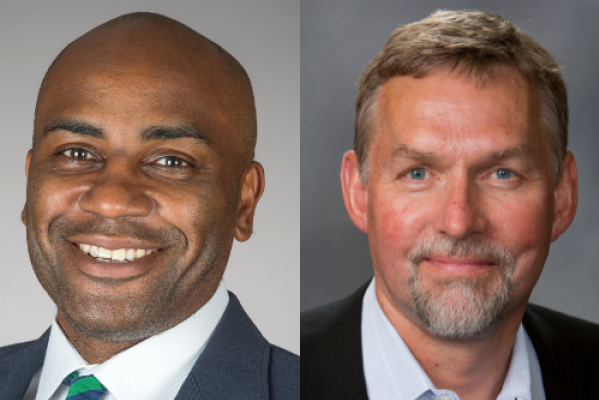
Morrell, associate dean for the humanities and equity in the , director of the 91Թ Center for Literacy Education and the Coyle Professor in Literacy Education, ranked 80th. This is the 10th year that he has been included in the rankings.
And Berends, the Hackett Family Director of the Institute for Educational Initiatives and professor of , placed 172nd. This is his sixth appearance on the list.
Ѵǰ’s research focuses on how the use of popular culture in the classroom can successfully engage urban youth and communities, as well as on translanguaging — the idea that students can maximize their learning by incorporating the many different languages they use every day.
He holds appointments in the departments of and . Morrell, who was elected to the National Academy of Education in 2022, is a fellow in the Kellogg Institute for International Studies and director of the National Council of Teachers of English James R. Squire Office of Policy Research in the English Language Arts. He also is a fellow of the American Educational Research Association (AERA).
Berends has written and published extensively on educational reform, school choice, the effects of family and school changes on student achievement trends, and the effects of schools and classrooms on student achievement.
His research focuses on how school organization and classroom instruction are related to student outcomes, with special attention to underserved students and school reforms aimed at improving their educational opportunities. He is currently conducting several studies on school choice, including an examination of the Indiana Choice Scholarship Program.
Berends is a member of the National Academy of Education and an AERA fellow. He also is a fellow with the Kellogg Institute for International Studies.
In addition, David Yaeger, a graduate of the ’s Teaching Fellows — a two-year 91Թ program in which participants earn a master’s degree in education while teaching in Catholic K-12 schools in the United States — placed 97th in the rankings.
Yaeger is now an associate professor of psychology at the University of Texas at Austin.
Rick Hess, director of education policy studies for the American Enterprise Institute, compiles the rankings. They are based on performances in nine categories, including publications, inclusion on syllabuses across the country, education press and web mentions, and mentions in the Congressional Record.
Originally published by on Jan. 8.
]]>The GC-DWC is partnering with Catholic Relief Services (CRS) and the Episcopal Commission for Catholic Education (CEEC) to implement Continuity of Learning, a four-year program in 170 schools. The consortium is uniquely poised both programmatically and operationally to leverage 91Թ’s, including the GC-DWC’s early-grade reading project Read Haiti (2016-20), its recent reading and social and emotional learning intervention Strong Beginnings (2020-24) and a strong relationship with the Haitian Ministry of Education at all levels made possible by partnering with CEEC.
“The GC-DWC’s partnership with the CEEC and CRS over the last eight years has resulted in the strongest education network in Haiti. These funds help us to meet the needs of learners and parents that were always there but have been exacerbated by national disasters and political uprisings,” said, the center’s director. “We are grateful to be able to continue to support education in Haiti through these awards.”
Through this program, children in first through fourth grades will benefit from a resilient education system that delivers uninterrupted access to a safe, quality education. The program will achieve the overarching goal through a four-pronged approach:
“We are excited to partner with Haitian educators and administrators to collect and leverage data to create sustainable and impactful opportunities for students,” said, GC-DWC’s director for Haiti and senior associate director for strategic planning.
]]>These awards —from the W.K. Kellogg Foundation, the LEGO Foundation and USAID — build on 91Թ’s long history in Haiti and its ongoing commitment to through the . The institute began its work expanding early-grade literacy after the 2010 earthquake and now serves 270 schools and dozens of Catholic parishes.
“With our partners in Haiti, we are building resilient child development and education systems that draw on the three pillars of Haitian society: the home, the school and the church,” said , the director for Haiti and senior associate director for strategic planning at the GC-DWC. “These new awards allow us to expand our work, especially in light of the damage caused by the 2021 earthquake.”
The awards support the following projects:
“The GC-DWC is excited to partner with Haitian educators, administrators, leaders and donors to respond to urgent needs in Haiti and build a stronger foundation for education moving forward,” said , the director of GC-DWC and a professor at 91Թ. “We hope these investments will go a long way toward creating pathways for learners to bright futures.”
]]>, the associate dean for the humanities and equity in 91Թ’s College of Arts and Letters, the Coyle Professor in Literacy Education and the director of the 91Թ Center for Literacy Education, ranked 71st in the 2022 list. Mark Berends, the Hackett Family Director of the Institute for Educational Initiatives, a professor of sociology and the director of the Center for Research on Educational Opportunity, placed 169th.
Ѵǰ’s focuses on how the use of popular culture in the classroom can successfully engage urban youth and communities and on translanguaging — the idea that students can maximize their learning by using the many different languages they use in their everyday lives. He also co-designed the first AP seminar on the African diaspora.
Morrell holds appointments in the University’s Department of English and Department of Africana Studies. He is a fellow in the Kellogg Institute for International Studies and the director of the National Council of Teachers of English James R. Squire Office for Policy Research in the English Language Arts. This is the eighth year he has been included in the rankings.
Berends has written and published extensively on educational reform, school choice, the effects of family and school changes on student achievement trends and the effects of schools and classrooms on student achievement. His research focuses on how school organization and classroom instruction are related to student outcomes, with special attention to underserved students and school reforms aimed at improving their educational opportunities. Currently, he is conducting several studies on school choice, including an examination of the Indiana Choice Scholarship Program.
Berends, who became director of the Institute for Educational Initiatives in July after a national search, is a member of the National Academy of Education, a fellow of the American Educational Research Association, and a fellow in the Kellogg Institute for International Studies. This is his fourth appearance on the list.
“These selections show the impact that 91Թ is having on K-12 education across the country,” Berends said. “We represent the many talented faculty in the institute who are working each day to improve the education of all children, especially the most disadvantaged.”
Rick Hess, the director of education policy studies for the American Enterprise Institute, compiles the rankings each year. The rankings are based on performances in nine categories that include publications, inclusion on syllabusesacross the country, education press and web mentions and mentions in the Congressional Record.
Also included in the rankings were two graduates of the ’s Teaching Fellows, a two-year 91Թ program in which participants earn a master’s degree in education while teaching in Catholic K-12 schools in the United States. David Yeager, now an associate professor of psychology at the University of Texas at Austin, placed 128th. Anna Egalite, now an associate professor in the Department of Educational Leadership, Policyand Human Development in the College of Education at North Carolina State University, placed 194th.
Originally published at on Jan. 6.
]]>St. Anthony of Padua School in Akron and St. Augustine Catholic School in Barberton will be part of ACE’s network, which creates thriving and resilient Catholic schools through an emphasis on Catholic school culture, strong teaching and learning and operational vitality.
Bishop Edward C. Malesic, J.C.L., joined in the announcement with Ryan Clark, the director of 91Թ ACE Academies, and Frank O’Linn, the superintendent of schools for the diocese.
“Since my arrival in Northeast Ohio almost a year ago, I have come to see that one of the great treasures of the diocese is our Catholic school system. In fact, Catholic education is one of the largest and most important youth ministries within our diocese,” Malesic said. “I am very grateful for the collaborative work between Dr. O’Linn, our education leadership and the 91Թ ACE schools to bring a most innovative, multifaceted program to two of our Akron-area Catholic schools, ensuring their academic excellence, accessibility and sustainability for years to come. The partnership of these schools will make them places where our children encounter the love and teaching of Jesus, giving them the best environment in which to flourish in their studies and personal formation. We want only the best for our children.”
The mission of the 91Թ ACE Academies is to provide a Catholic education of the highest quality to as many children as possible by mobilizing the resources of the University, (arch)dioceses, statewide parental choice programsand local communities. ACE faculty and staff will work closely with local leadership of 91Թ ACE Academies in greater Akron to increase academic achievement, boost enrollment and strengthen the schools’ Catholic identity by enhancing school leadership, curriculum, instruction, professional development, financial management and marketing.
“Catholic education is at a crossroads today, and we are increasingly challenged to sustain Catholic schools in all communities, but especially those with limited resources,” O’Linn said. “Our collaboration with 91Թ ACE Academies will strengthen educational opportunities for all young people, especially the most vulnerable, through leadership, research and innovative practices. I am excited about their arrival in our diocese in Akron, which has seen numerous elementary school closures in recent years. This partnership will support children’s ongoing opportunity to grow academically, personally and spiritually through Catholic education.”
91Թ ACE Academies were founded in 2010 as a response to the U.S. Conference of Catholic Bishops’ call for a “new model of sponsorship and collaboration” between Catholic institutions of higher education and parish schools. The network has heeded the call and has experienced both academic and enrollment gains in its schools. The generosity of several notable benefactors, including Greg and Tricia Griffith, Tom and Ginny Jeckering, the Humble Heart Gentle Soul Foundation, the McGinty Family Foundation and select other anonymous donors, made this partnership possible.
“After spending time in these two schools and learning about the opportunity to strengthen schools that have been serving the Akron and Barberton communities for decades, we knew it was a good fit for our formation and support program,” Clark said. “It’s an opportunity to show how we can be stronger together.”
For more about ACE and the 91Թ ACE Academies, visit .
Contact:Theo Helm, 574-631-3893, thelm1@nd.edu
]]>The two-year project will engage schools that are a part of the W.K. Kellogg Foundation’s Model School Network in the Central Plateau of Haiti, a region with a difficult topography, high rates of poverty and limited scalable and effective academic interventions. Given these realities, the network seeks to improve outcomes of students in the Central Plateau through sustainable, multilayered, data-drivenand effective governmental and civil society partnerships.
This latest award will be leveraged to enhance Haitian schools’ capacities to collect and use relevant data to drive informed decision-making. The project brings together the GC-DWC Haiti, 91Թ’s and the Université Quisqueya in Haiti to equip local schools with the skills and tools necessary to increase capacity for multilevel data collection, annual benchmarking, evaluationand visualization.
“In the context of a low-income country such as Haiti, with a chronic lack of investment in education, the role of scalable, cost-effective and culturally appropriate interventions that embrace data-informed approaches cannot be overlooked,” said , the founding director of the GC-DWC and principal investigator on the project. “There is an urgent opportunity to provide capacity-building resources to Haitian education networks at the school level and to equip them with the tools to leverage data effectively in order to improve student outcomes.”
The GC-DWC and its partners will develop a school-based information system tailored to the needs of the Model School Network, build schools’ capacity for the implementation of data collectionand provide ongoing support and professional development to schools. These processes will ensure that data are used to address gaps in students’ educational experiences and to strengthen current curriculum and school practices. In particular, CEHI will leverage its data expertise to build a functional and robust data platform at both the school and national levels.
“In the Haitian education system, robust data and data systems can provide an energizingsource of power, change and innovation,” said, the Charles and Jill Fischer Provost of the University of 91Թ and director of CEHI. “We are excited to partner with Haitian educators and administrators to collect and leverage data to create sustainable and impactful opportunities for students.”
]]>The academy advances high-quality research that improves education quality and practice. Members are elected on the basis of outstanding scholarship related to education.
In addition to directing the Center for Research on Educational Opportunity, Berends chairs the faculty committee of the 91Թ Program for Interdisciplinary Educational Research, is a Fellow in the Institute for Educational Initiativesand serves on the Institute’s faculty committee. He is also a Fellow in the Kellogg Institute for International Studies.
“Mark’s research has provided invaluable perspective on how we can improve the education of all youth, particularly the disadvantaged,” said the acting director of the institute and the executive director of the . “I am so happy to see his work recognized by the academy.”
“I am deeply honored to be invited to join the academy,” Berends said. “It is an incredibly distinguished group of thinkers and researchers, and I am proud to be a part of it.”
Berends has written and published extensively on educational reform, school choice, the effects of family and school changes on student achievement trends and gapsand the effects of schools and classrooms on student achievement.His research focuses on how school organization and classroom instruction are related to student outcomes, with special attention to disadvantaged students and school reforms aimed at improving their educational opportunities.Within this agenda, he has applied a variety of quantitative and qualitative methods to understanding the effects of school reforms on teachers and students.
Currently, he is conducting several studies on school choice, including an examination of the Indiana Choice Scholarship Program, parent decision-making and satisfaction in a lottery-based study of charter schoolsand how organizational and instructional contexts are related to student outcomes in charter, voucherand traditional public schools. Berends serves on numerous editorial boards, technical panelsand policy forums; he is a fellow of the American Educational Research Association (AERA); former co-editor of AERA’sAmerican Educational Research JournalandEducational Evaluation and Policy Analysisand twicethe vice president of the AERA’s Division L, Educational Policy and Politics. His latest books areSchool Choice and School Improvement(Harvard Education Press, 2011),School Choice at the Crossroads: Research Perspectives(Routledge, 2019), Handbook of Research on School Choice, 2nd Edition(Routledge, 2020)and theInternational Handbook of the Sociology of Education(SAGE, forthcoming).
Berends is one of 15 newly elected members who will be inducted November 6 in Washington, DC. Academy members are elected on the basis of outstanding scholarship related to education. Nominations are submitted by individual Academy members once a year for review and election by the organization’s membership.
“These diverse scholars are at the forefront of those who are improving the lives of students in the United States and abroad through their outstanding contributions to education scholarship and research,” Ladson-Billings said.
Originally published by at on February 25, 2020.
]]>