Blitzer's talk, will take place at 4 p.m. on Feb. 26 (Wednesday) in the auditorium of the Hesburgh Center for International Studies. The event is free and open to the general public; no tickets are required.
, the Marilyn Keough Dean and professor of global affairs in the Keough School of Global Affairs, will introduce Blitzer at the event. After the lecture, Blitzer will take audience questions and have a conversation with , associate professor of law at 91³Ô¹Ï Law School and director of the Klau Institute.
Blitzer’s presentation ties in with the Klau Institute’s , which launched last year through collaboration with other experts from across the Keough School and the University as a whole. The Migration Initiative is supported in part by the , a University-wide effort to expand knowledge about what works to alleviate poverty.
“We are thrilled to host Jonathan Blitzer for this timely discussion on immigration,†McAward said. “His reporting from the U.S.-Mexico border offers important perspectives to help us understand the human experience, and the issues of human dignity, related to migration.â€
Blitzer, a staff writer for The New Yorker, has won several awards for his immigration reporting.

His book, “Everyone Who Is Gone Is Here: The United States, Central America, and the Making of a Crisis,†is a deeply reported history of the political conflicts, policy choices and corruption that have led to the current crisis at the U.S.-Mexico border. He tells this history through personal stories of Central American migrants as well as American activists, government officials and politicians. “Everyone Who Is Gone Is Here†has received widespread praise and was named one of the best books of 2024 by The New York Times and several other publications.
A reception with hors d’oeuvres will follow the event. “Everyone Who Is Gone Is Here†will be available for sale, and Blitzer will remain on hand to sign copies of the book.
The event is co-sponsored by the , , , Â and the .
Originally published by at on Feb. 14.
Contact: Tracy DeStazio, associate director of media relations, 574-631-9958 or tdestazi@nd.edu
]]>Stevenson’s talk is scheduled for 6 p.m. Oct. 15 at the Morris Performing Arts Center in downtown South Bend. Everyone in the community is invited, there is no cost to attend, and no ticket is required. Doors will open at 5 p.m. A free shuttle will be available between 91³Ô¹Ï’s campus and downtown on the evening of the event.Â
Stevenson’s talk is this year’s . Established in 2009, the lecture invites exemplars from diverse fields who share the Center for Social Concerns’ abiding commitments to human dignity and the common good.
Stevenson’s lecture is also part of the , which is organized around the theme “What Do We Owe Each Other?â€
University President , will introduce Stevenson at the event.
“It is a privilege to welcome a leader whose public life has been guided by the question at the heart of this year’s 91³Ô¹Ï Forum in the way that Bryan Stevenson’s has,†Father Dowd said. “For more than 30 years he has worked with tireless commitment to advance economic and racial justice in our country, and his example is an inspiration to us all.â€
This is the first time that the Rev. Bernie Clark, C.S.C., Lecture is being held off campus.
“I cannot imagine a more perfect person than Bryan Stevenson to serve as this year’s distinguished lecturer. His lifelong commitment to justice has been extraordinary,†said Suzanne Shanahan, the Leo and Arlene Hawk Executive Director of the Center for Social Concerns.
“To be hosting this conversation in the heart of our community makes it even more special,†Shanahan said. “We are thrilled that we will all be able to benefit from Stevenson’s experience and wisdom. Our hope is that we will share in those challenging conversations about racial justice as we together aspire to a more just carceral system.â€
Stevenson is the founder and executive director of the Equal Justice Initiative, a human rights organization based in Montgomery, Alabama. His memoir, “Just Mercy: A Story of Justice and Redemption,†became a bestseller and was adapted into a feature film in 2019 starring Michael B. Jordan, Jamie Foxx and Brie Larson.
Stevenson has won multiple U.S. Supreme Court cases, including a 2019 ruling that protects condemned prisoners who suffer from dementia and a 2012 ruling that banned sentences of mandatory life imprisonment without parole for children 17 or younger. He and his staff have won reversals, relief or release from prison for more than 140 wrongly condemned prisoners on death row and won relief for hundreds of others who were wrongly convicted or unfairly sentenced.
In addition, Stevenson led the creation of the Equal Justice Initiative’s Legacy Sites, which include the Legacy Museum, the National Memorial for Peace and Justice, and Freedom Monument Sculpture Park. These powerful new landmarks in Montgomery chronicle the nation’s legacy of slavery, lynching and racial segregation while making connections to today’s crisis of mass incarceration and contemporary issues of racial bias.
Stevenson’s lecture is co-sponsored by several other units at 91³Ô¹Ï: the , the , the , the and the .
Find more details about Stevenson’s lecture, including location, parking and shuttle information, at .
Originally published by at on Oct. 9.
]]>
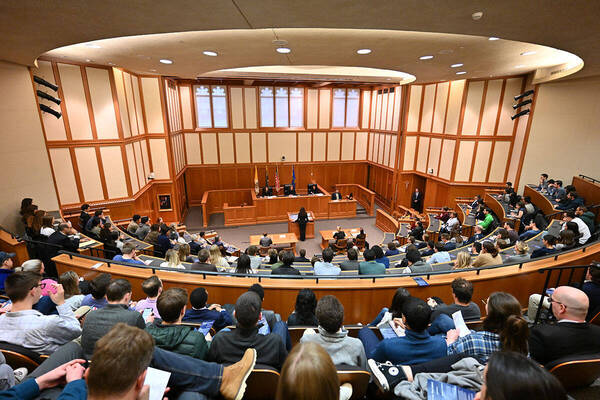
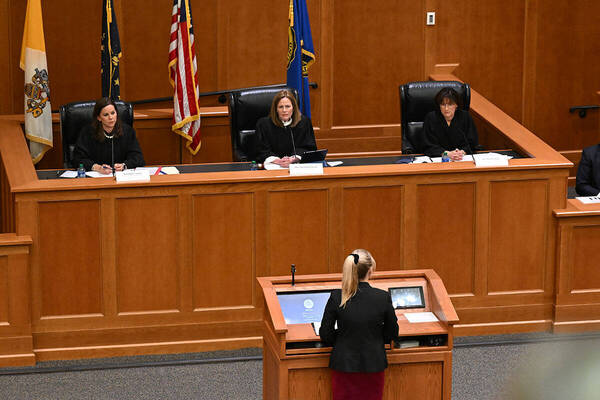
Four 91³Ô¹Ï Law School students had the opportunity to argue a case in front of a panel of distinguished federal judges on Feb. 6 at the Law School’s 73rd annual Moot Court Showcase Argument.
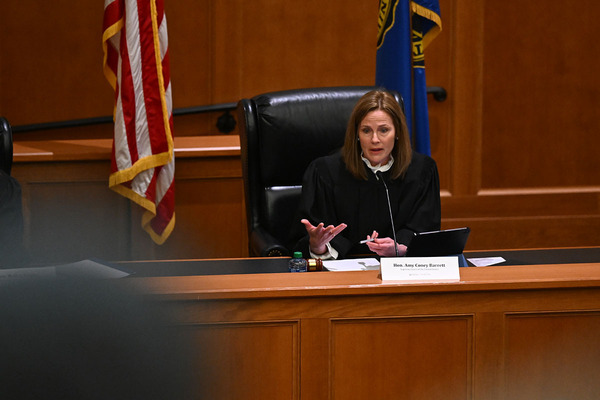
The judges for this year’s showcase argument were Associate Justice Amy Coney Barrett of the Supreme Court of the United States, Judge Britt Grant of the U.S. Court of Appeals for the Eleventh Circuit, and Chief Judge Diane Sykes of the U.S. Court of Appeals for the Seventh Circuit.
The fictitious case chosen for the exercise, St. Agatha High School v. Vanessa Benson and the State of Hoynes, concerned a teacher at a Catholic school who was fired for creating social media posts that rejected and contradicted the school’s religious teachings. Third-year law students Olivia Rogers and Leo O’Malley advocated for the school’s position, while third-year law students Courtney Klaus and Elisabeth Crusey advocated for the teacher’s position.
The case involved issues such as whether the religion clauses prevent civil courts from adjudicating employment discrimination claims brought by an employee against her religious employer when the employee’s job description contains religious responsibilities, and whether the fictitious Hoynes Supreme Court erred in concluding that the state’s human rights act was neutral and generally applicable.
91³Ô¹Ï Law School hosts the annual Moot Court Showcase Argument for the primary purpose of providing first-year law students with an opportunity to see effective oral advocacy in action. The Law School’s McCartan Courtroom was filled to capacity with spectators on Feb. 6.
The three judges listened to the advocates and asked them questions for more than 45 minutes before concluding the argument and offering feedback to the students. Barrett quipped that the judges were “in the fortunate position of neither having to decide the case, write an opinion nor pick a winner.â€
Barrett complimented Rogers, O’Malley, Klaus and Crusey on their presence and composure. She observed that the students did not rely on their notes during oral advocacy and that they were willing to embrace the implications of their arguments and where their arguments would lead. Those are marks of good oral advocates, Barrett said.
Grant added that the students did a good job of being conversational with the judges, embracing the judges’ questions and being open to what those on the bench wanted to hear about the case.
Sykes called the students “excellent oral advocates.†In addition, Sykes said she was impressed with the students’ complete command of the legal material relevant to the case.
“I am incredibly grateful to Justice Barrett, Judge Sykes and Judge Grant. Their willingness to support and encourage future generations of lawyers is an inspiration,†O’Malley said after the showcase argument. “It is hard to describe the mix of emotions I had stepping up to the podium in the McCartan Courtroom. Suffice it to say, arguing in front of such a distinguished panel is an experience that I will always remember.â€
Klaus, Crusey and Rogers also said they were honored to have the opportunity to argue in front of a Supreme Court justice and two federal Court of Appeals judges.

“It’s a tremendous privilege that not many people — let alone law students — get to experience. It’s something I’m going to remember for the rest of my life,†Klaus said.
Crusey said, “Participating in this year’s showcase argument taught me valuable skills in oral advocacy, which I will carry with me throughout my career. We are deeply grateful for everybody’s time and support of 91³Ô¹Ï Moot Court.â€
Rogers said, “Arguing in front of such a distinguished panel of judges would be an honor and privilege at any point in my career, and even more so as a student. I really enjoyed diving into religious liberty issues to prepare for the showcase, and am so thankful to my teammates, professors and the judges for making this possible.â€
The Moot Court Showcase Argument is put on each year by student members of the 91³Ô¹Ï Law School Moot Court Board.
“The annual showcase argument is really a testament to amazing opportunities that 91³Ô¹Ï Law School provides to its students,†O’Malley said. “I feel so blessed to have been part of this longstanding tradition and would like to thank everyone who made this year’s event possible.â€
Klaus added, “I want to thank my amazing teammates who worked for months to make this happen. We all care a lot about setting a good example of appellate advocacy for the 1Ls and being a part of this awesome tradition. I couldn’t be prouder of everyone.â€
Visit to learn more about Moot Court at 91³Ô¹Ï Law School.
Originally published by at on Feb. 14.
]]>Biolchini Family Professor Emeritus of Law was made a Commander of the Order of the British Empire for his services to legal scholarship.
Finnis — renowned throughout the world for his work in moral, political and legal theory and constitutional law — taught and researched at 91³Ô¹Ï from 1995 to 2020. He previously taught at the University of Oxford in England, where he now resides in his retirement and continues to be a professor emeritus of law and legal philosophy at Oxford.
“I am thrilled that Professor John Finnis received this recognition. He is one of the greatest legal minds of all time, and it’s always a delight to celebrate the impact of his work,†said , the Joseph A. Matson Dean and Professor of Law at 91³Ô¹Ï Law School. “Our students and faculty — myself included — have been blessed to count John Finnis as a friend, colleague and mentor. We are cheering the news of his latest honor, which is richly deserved.â€
Finnis’ towering career as a teacher and scholar has produced classic, influential works such as “Natural Law & Natural Rights,†published in 1980 by Oxford University Press.
During his 25 years at 91³Ô¹Ï, Finnis published seminal works including “Aquinas: Moral, Political and Legal Theory†(Oxford University Press, 1998), a second edition of “Natural Law & Natural Rights†(Oxford University Press, 1980, 2011) with an 80-page postscript, five volumes of the “Collected Essays of John Finnis†(Oxford University Press, 2011), and in 2013 his 123-page “Reflections and Responses†in “Reason, Morality and Law: Essays in Honour of John Finnis,†edited by John Keown and Robert P. George (Oxford University Press, 2013). Throughout those 25 years he co-edited the American Journal of Jurisprudence, first with Professor and later with Professor . He remains a permanent distinguished senior research fellow at the University of 91³Ô¹Ï’s .
In fall 2021, Pojanowski organized a conference to celebrate Finnis’ work. The conference, was held at 91³Ô¹Ï’s London Global Gateway.
“My 25 years in the Biolchini Family Chair were an incomparable opportunity that I profoundly appreciated from beginning to end, for the teaching, the research facilities, and the scholarly and collegial interaction with students and colleagues at 91³Ô¹Ï Law School,†Finnis said this week. “It was an opportunity also, as it turned out, to inaugurate an interaction between the law faculties of Oxford and 91³Ô¹Ï that is continuing and I hope will bring much good fruit for both universities for many years.â€
Finnis earned his LL.B. in 1961 from Adelaide University in his home country, Australia, and his doctorate in 1965 from Oxford University as a Rhodes Scholar at University College Oxford.
His other honors have included being elected in 1989 a fellow of the British Academy, in both the law and philosophy sections, and in 2019 a Companion of the Order of Australia. The citation for the latter, Australia’s highest civil award, was: “For eminent service to the law, and to education, to legal theory and philosophical enquiry, and as a leading jurist, academic and author.â€
When Queen Elizabeth II appointed him honorary Queen’s Counsel in 2017, the Lord Chancellor’s office announced: “He is a leading legal philosopher and legal scholar at Oxford University and 91³Ô¹Ï. Many of his former students have gone on to teach at prestigious universities around the world, or to sit in the higher courts in England and Wales and beyond. Over his long and distinguished academic career in the law faculties at Oxford and at 91³Ô¹Ï, Professor Finnis has made a prolific and peerless contribution to legal scholarship. He is known for his work in the tradition of classical natural law thought, which has transformed the study of jurisprudence across the world. He is also a distinguished authority in other areas of law, particularly constitutional law and medical law, and his work in these areas has been cited by the UK Supreme Court and the Court of Appeal. Professor Finnis has dedicated himself for many years to the service of legal scholarship and legal education and at the very highest level.â€
Originally published by at on Jan. 6.
]]>The summit’s theme is Dignitatis humanae — the Second Vatican Council’s declaration on religious freedom that spelled out the Catholic Church’s support for the protection of religious liberty and set the ground rules for how the Church would relate to secular states.
The inaugural 91³Ô¹Ï Religious Liberty Summit in 2021 was held on the University of 91³Ô¹Ï’s campus. This year’s summit in Rome underscores the Religious Liberty Initiative’s global reach.
“Religious liberty is a fundamental human right, and the protection of religious liberty is a global issue,†said , the Joseph A. Matson Dean and Professor of Law at 91³Ô¹Ï Law School.
“Everyone around the world has the God-given right to live their lives as their beliefs require — proudly and without fear,†Cole said. “The Religious Liberty Initiative at 91³Ô¹Ï Law School has the potential to change the world by promoting and defending freedom of conscience for people and institutions around the world.â€
Established by Cole in 2020, the 91³Ô¹Ï Law School Religious Liberty Initiative promotes and defends religious freedom for people of all faiths through scholarship, events and the Law School’s Religious Liberty Clinic. The initiative protects the freedom of individuals to hold religious beliefs as well as their right to exercise and express those beliefs and to live according to them.
The Religious Liberty Initiative has represented individuals and organizations from an array of faith traditions to defend the right to religious worship, to preserve sacred lands from destruction, to promote the freedom to select religious ministers and to prevent discrimination against religious schools and families.
The summit will stimulate conversations among scholars, advocates and religious leaders about the future of religious liberty in the United States and around the world.
Although in-person attendance at the summit is by invitation only, the schedule will include several panel discussions and speeches that will be recorded and available for the public to view on .
The 2022 91³Ô¹Ï Prize for Religious Liberty will be presented to Mary Ann Glendon, the Learned Hand Professor of Law, emerita, at Harvard Law School and former U.S. ambassador to the Holy See. Glendon is being honored for groundbreaking legal scholarship as well as her distinguished service to the United States and the Catholic Church — all of which have had a global impact by affirming religious freedom as a fundamental human right.
Steven Smith, professor of law and co-executive director of the Institute for Law and Religion at the University of San Diego School of Law, will receive the Religious Liberty Initiative’s 2022 Award for Scholarship.
Another highlight of the summit will be the keynote discussion on July 22 between two of the world’s foremost philosophers and public intellectuals — Cornel West of Union Theological Seminary and Robert P. George of Princeton University.
will be recorded at the Religious Liberty Summit and posted on for the public to view.
Learn more about 91³Ô¹Ï Law School’s Religious Liberty Initiative at .
Originally published by at on July 11.
]]>91³Ô¹Ï Law Professor is clerking for Associate Justice Neil Gorsuch. 91³Ô¹Ï Law School graduate is clerking for Associate Justice Brett Kavanaugh.
“Professor Barclay’s service to the nation’s highest court will benefit her students and her scholarship immensely,†said G. Marcus Cole, the Joseph A. Matson Dean and Professor of Law at 91³Ô¹Ï Law School. “Her experience as a U.S. Supreme Court clerk will be reflected in her teaching and her scholarship for the rest of her career.â€
Barclay joined the Law School’s faculty in 2020 and has served as director of the new . Her research focuses on the role democratic institutions play in protecting minority rights, particularly at the intersection of free speech and religious exercise. She clerked previously for Judge N. Randy Smith of the U.S. Court of Appeals for the Ninth Circuit.
Barclay is one of 14 current faculty members at 91³Ô¹Ï Law School who have clerked at the Supreme Court. That equals one-third of the Law School’s tenure-track faculty members.
Baltes is the third 91³Ô¹Ï Law School graduate in three years to clerk for a Supreme Court justice. Laura Wolk ’16 J.D. and Audrey Beck ’17 J.D. clerked during 2019-20 term.
Baltes clerked previously for Judge Raymond Gruender of the U.S. Court of Appeals for the Eighth Circuit and for then-Judge Amy Coney Barrett of the U.S. Court of Appeals for the Seventh Circuit. Barrett, a 91³Ô¹Ï Law School alumna and longtime faculty member, was appointed as an associate justice of the Supreme Court in 2020.
The 37 lawyers clerking at the Supreme Court this term are alumni of just 12 law schools.
91³Ô¹Ï is the only law school that has a faculty member and a graduate on this year’s roster of clerks.
Originally published by at on °¿³¦³Ù.Ìý12.
]]>Smithburn joined the 91³Ô¹Ï Law School faculty in 1978 after serving as a judge in Marshall County, Indiana. In addition to family law and juvenile law, his academic interests included evidence and appellate review. He was a sought-out speaker in judicial circles nationwide and wrote several highly regarded books.
He masterfully directed 91³Ô¹Ï Law School’s summer program in London from 1984 to 2000. Under his leadership, the 91³Ô¹Ï program attracted and enrolled students from law schools across the United States. He was also admitted as a barrister in the United Kingdom.
In addition to his responsibilities as a professor, Smithburn served as a senior judge in the St. Joseph County Probate Court and continued to serve on the bench after retiring from the law faculty in 2015.
“91³Ô¹Ï Law School has reached its current place among the nation’s best law schools in part because of the contributions of Eric Smithburn,†the Joseph A. Matson Dean and Professor of Law said.
Colleagues described Smithburn, who stood 6-foot-4, as a big man with a big heart, big laugh and big love for family and life in general.
“I always thought of Eric as a gentle giant,†said Professor Emerita Patricia O’Hara, who served as the Law School’s dean from 1999 to 2009.
“Beneath his physical exterior, honed from years as an adult on the rugby field, was a compassion deepened by his experience as a trial court judge dealing with families and youths in crisis, as well as by his own loss of his infant son, Conner,†O’Hara said. “To enter his faculty office was to step back in time and see curios inherited from his parents that were not important to him because of their intrinsic value, but because he treasured family. Eric took deep pride in the professional reputation as a lawyer enjoyed by his wife, Aladean, and regaled colleagues with the accomplishments of his son, Scott, and his stepdaughter, Kylea.â€
Professor Emeritus Fernand “Tex†Dutile said Smithburn was multidimensional.
“He loved his family, the law, athletics, music, the Lizzie Borden case and London. Surely this love of London, coupled with hard work, attention to detail and care for the richness of the students’ experience, propelled him, as director, to keep 91³Ô¹Ï’s London summer law program as the very best such American program over the entire span of his 16 years’ leadership,†Dutile said. “Always cheerful, warm and ready to laugh, he enriched the faculty. He brought to us a unique perspective that was uniquely valuable.â€
Professor Jay Tidmarsh also noted Smithburn’s love of the English legal system. “I recall when Eric was called to the bar of England and Wales. It was one of his proudest accomplishments: from small-town Indiana lawyer to international practice,†Tidmarsh said.
Among Smithburn’s highly regarded books were the West Indiana Practice volumes on Family Law — authoritative sources that he co-authored with South Bend attorney and 91³Ô¹Ï Law graduate Ann Carol Nash.
“We spent many hours talking about life and law,†Nash said. “What impressed me most was that, while we discussed the nuances of cases and statutes, he never forgot how profoundly the law affects the people involved in family law.â€
Peter Tomas Morgan was in Smithburn’s evidence course as a law student. After graduation, Morgan argued cases in front of Smithburn while the professor was serving as a probate court judge. Morgan later became executive director of the St. Joseph Probate Court/Juvenile Justice Center, where Smithburn maintained an office as a senior judge.
“I will never pass down the words, the arguments, the statements of the kind which he left behind,†Morgan said. “But as much as I value these, I value more how he has inspired me to be present to the person in front of me, whether in the courtroom, in the law office or on the street, with fairness, with respect, with a genuine belief that we can all be our better selves.â€
A private burial was held for Smithburn. A celebration of his life will take place on a later date.
]]>The summit, to be held on 91³Ô¹Ï’s campus, will stimulate conversations between scholars, advocates and religious leaders about the future of religious liberty in the United States and around the world.
Cardinal Timothy Dolan, the Archbishop of New York, will deliver a keynote address, followed by a panel on interfaith cooperation with Elder Quentin L. Cook of the Quorum of the Twelve Apostles, Rabbi Meir Y. Soloveichik of the Congregation Shearith Israel, and Jacqueline Rivers of the Seymour Institute.
Nury Turkel of the U.S. Commission on International Religious Freedom will receive the first 91³Ô¹Ï Prize for Religious Liberty. Turkel, a Uyghur American attorney and human rights advocate appointed by House Speaker Nancy Pelosi, is being recognized for his inspired advocacy on behalf of Uyghurs of western China. A largely Muslim ethnic group, the Uyghurs have courageously refused to abandon their faith and culture despite severe oppression from the Chinese Communist Party.
Other events on the summit schedule include panels on topics such as overcoming the polarization of religious liberty, international threats to religious liberty, and addressing what every religious group should know when working with the media. The media panel will feature Elizabeth Dias of the New York Times, Emma Green of The Atlantic, Eric Marrapodi of NPR and others.
Green will also participate in a book discussion with Asma T. Uddin, author of “The Politics of Vulnerability: How to Heal Muslim-Christian Relations in a Post-Christian America.†Uddin is the inaugural recipient of an award that the Religious Liberty Initiative will present annually to honor a recent work of scholarship on religious liberty.
The summit will not be open to the general public for in-person attendance, but Cardinal Dolan’s speech and several other sessions will be available to watch on . See the full schedule .
“Everyone knows that religious liberty is the very first freedom mentioned in the First Amendment of our Bill of Rights in the United States. But religious liberty is more than that — it’s a human right — and it’s under threat all around the world,†said , the Joseph A. Matson Dean and Professor of Law at 91³Ô¹Ï Law School.
Freedom of conscience is a life-or-death issue in a lot of countries, Cole said, noting the examples of Uyghurs in China as well as the 13 nations where atheism is punishable by death. In the United States, he said, religious liberty means the difference between a person being able to live their faith on a daily basis or having to do things that violate that faith.
“The Religious Liberty Initiative is assembling scholars from all around the world to study and inform the debates surrounding these issues,†he said.
The Religious Liberty Initiative was born of a promise that Cole made to University President Rev. John I. Jenkins, C.S.C., upon becoming the Law School’s dean in 2019. The initiative aims to put 91³Ô¹Ï on the forefront of scholarship and advocacy in this dynamic and important area of the law.
The initiative promotes religious freedom for people of all faiths through scholarship, events and the Religious Liberty Clinic. The groundbreaking new clinic will train future 91³Ô¹Ï lawyers to defend religious freedom by pursuing claims in trial courts as well as appeals up to and including the U.S. Supreme Court.
During this past academic year, a cohort of 91³Ô¹Ï Law students led by the Religious Liberty Initiative’s faculty director, Professor , filed amicus briefs in several cases, including on behalf of that saw their schools and synagogues shut down by discriminatory COVID-19 policies in New York; trying to prevent a copper mine from destroying an indigenous sacred site in Arizona; and challenging Maine’s exclusion of religious schools from the state’s school choice program.
The initiative also hosted several events, including panel discussions on and .
“91³Ô¹Ï’s Religious Liberty Initiative is focused on creating and promoting religious liberty scholarship, and then leveraging those ideas to protect real people of all faiths,†Barclay said. “Given 91³Ô¹Ï’s institutional support and deep faculty expertise on religious liberty issues, we are well positioned to operate at the confluence of theory and real-world impact.â€
The 91³Ô¹Ï Religious Liberty Summit will be held in cities around the world in years ahead. 91³Ô¹Ï will host the summit in Rome in 2022 and Jerusalem in 2023.
“What we are building here at 91³Ô¹Ï has the potential to change the world,†Cole said.
The summit is co-sponsored by the University of 91³Ô¹Ï’s Ansari Institute for Global Engagement with Religion, the 91³Ô¹Ï Center for Citizenship and Constitutional Government and the Bech-Loughlin First Amendment Center at the University of Texas School of Law.
to receive news and updates, including links to the summit broadcasts on June 28-29.
Originally published by at on June 2.
]]>Inspired by the writings of St. Thomas Aquinas, Broden conceived of the law as an instrument to advance the greater good, and in particular to protect the rights and dignity of individuals with less power and influence in society. He joined the 91³Ô¹Ï Law School faculty in 1950 and served the University, the South Bend community and the U.S. government in numerous ways.
Broden taught a wide variety of courses, including jurisprudence, criminal law and administrative law. For many years, he also taught a course called Law and Poverty, in which students spent a semester working with a local community organization. In 1965, he worked with the federal government to start the nationwide Legal Services Program to assist low-income persons, and the program he started with 91³Ô¹Ï and the surrounding South Bend community served as the model for programs later initiated at other law schools.
Former 91³Ô¹Ï Law School Dean was a student when he met Broden.
“He was my professor in my first year of law school. I always thought he was a great professor,†said Link, who returned to 91³Ô¹Ï to join the law faculty in 1970 and served as dean from 1975 to 1999.
“It was wonderful to have him on the faculty. First of all, he was a great teacher, always prepared. I never received one complaint about him as a teacher,†Link said. “But as a community leader, he was magnificent. He was very caring. He really cared about people. It wasn’t just academic; he really thought about the people for whom he was advocating.â€
Broden’s long list of accomplishments includes playing an integral role in the creation of the U.S. Civil Rights Commission in 1956. As counsel to the U.S. House of Representatives Judiciary Committee, he was the staff attorney-in-charge of the first civil rights bill since the post-Civil War Reconstruction Era. From 1967 through 1969, he directed training and technical assistance for the federal Anti-Poverty Program. And in 1970, he began the University’s Institute for Urban Studies and served as its director for 20 years. Under his leadership, the institute conducted research and educational activities to promote equality of opportunity, to develop strategies for urban ministry and to find ways to improve the lives of those living in poverty.
, a 1974 91³Ô¹Ï Law School graduate who served as dean from 1999 to 2009, said Broden was the last of a legendary cohort of senior faculty dating back to the tenure of Deans Clarence Manion and Joseph O’Meara — a cohort that included Frank Booker, Conrad Kellenberg, Ed Murphy, Charlie Rice, Bob Rodes and Peter Thornton.
“Countless alumni, now in senior ranks themselves, have regaled me with stories of these men who shaped the Law School over a period of four decades in the second half of the 20th century,†O’Hara said.
Long before clinical legal education existed as a discipline, Broden was at the forefront of bridging academic theory with experiential learning, O’Hara said.
Professor , who served as the Law School’s dean from 2009 to 2019, concurred that Broden was one of the giants of 91³Ô¹Ï Law School.
“He made his mark not just on our students, but also on the larger community,†Newton said. “Tom truly understood that the law should serve those at the margins and that justice has to consider the greater good. He will be sorely missed.â€
, the Law School’s associate dean for experiential programs, called Broden’s life a relentless and creative pursuit of social justice.
“He did not merely join causes. He created novel institutions and strategies to redress poverty and racial injustice,†Jones said. “Among other innovations, he invented clinical legal education at 91³Ô¹Ï, creating a model for the nation, at a time when few had the imagination to understand the contribution that law students could make to their communities by providing free legal services.â€
Broden was honored on many occasions for his service to 91³Ô¹Ï and the community. His awards include the 91³Ô¹Ï Presidential Award (1976), for which University President Rev. Theodore M. Hesburgh, C.S.C., described Broden as “a man who has brought the best of the academy to the promise of our city.†The University also honored him with its Reinhold Niebuhr Award for Social Justice (1978) and its John Cardinal O’Hara Award (1995) that acknowledges former employees whose personal life reflects 91³Ô¹Ï’s principles. Pope Paul VI inducted him as a knight into the Order of St. Gregory the Great in 1965, a title discerned to lay persons for “the renown of their deeds.â€
“Over the years, the University and local community bestowed on Tom every possible honor to recognize his unparalleled service to those in our midst who are most marginalized — tributes he did not seek and never mentioned,†O’Hara said. “He was a gentleman in the truest sense of the word — a gentle man who was a champion of working for peace by fighting for justice for all.â€
Broden was preceded in death by his beloved wife, Joanne, to whom he was married for 70 years. He is survived by their five children, nine grandchildren and two great-grandchildren.
Arrangements are pending.
]]>In his appointed role as , Alford was responsible for managing the Antitrust Division’s international work, including developing policy on issues of international antitrust enforcement and promoting the enforcement of antitrust laws around the world.
His team was tasked with drafting the competition chapter of the United States-Mexico-Canada Agreement, also known as NAFTA 2.0.
The DOJ led to establish globally accepted standards for due process in competition law enforcement proceedings. Alford delivered in 13 countries as part of the campaign. The agreement, known as the ICN Framework for Competition Agency Procedures (CAP), has been signed by competition agencies from . By signing the CAP, agencies guarantee that they will respect fundamental due process norms, including nondiscrimination, transparency, right to counsel, notice and opportunity to defend, confidentiality and judicial review.
During his U.S. Department of Justice service, Professor Roger Alford delivered more than two dozen speeches around the world, including at the 2019 China Competition Policy Forum in Hainan.
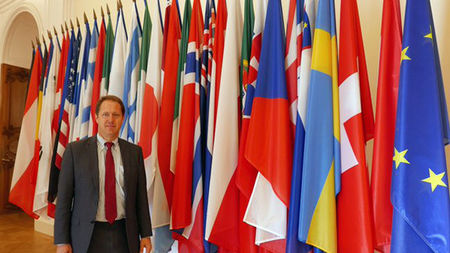
Professor Roger Alford is pictured at the Organisation for Economic Co-operation and Development in Paris, where he attended the 2017 Global Strategy Group Meeting.
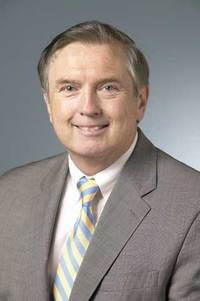
Alford, who joined 91³Ô¹Ï Law School’s faculty in 2012, has focused on international business law throughout his career. “I was teaching full-time for 17 years before taking the post with the DOJ,†he said. “It was beneficial to work at a senior level in government in an area of great importance to the economy. This is an area where law and economics intersect.â€
, the Joseph A. Matson Dean and Professor of Law at 91³Ô¹Ï Law School, emphasized the indirect benefits to students of learning from Alford’s role on the world stage.
“The impact of Roger Alford’s experience as the leading American policymaker on international antitrust law cannot be overstated,†Cole said. “Roger was a major force in shaping the legal framework of the global economy for years to come. His students at 91³Ô¹Ï have the advantage of learning international antitrust law from one of the minds that crafted it.â€
Makan Delrahim, assistant attorney general for the DOJ’s Antitrust Division, said the DOJ and the Antitrust Division benefited tremendously from Alford’s leadership as deputy assistant attorney general for international affairs.
“More importantly, consumers and companies around the world will benefit for generations to come from the groundbreaking work Roger did while at the division,†Delrahim said. “Roger’s expertise in international law and legal procedures made him the perfect choice to lead the United States’ effort at creating international consensus and enforcement mechanisms to ensure due process for companies facing competition law inquiries around the world. His dedicated and skillful leadership was pivotal in achieving the first-of-its-kind Framework on Competition Agency Procedures. The international business and competition law communities owe him a debt of gratitude.â€
Globalization and the proliferation of market economies since the end of the Cold War have raised the need for globally accepted standards for due process in competition law enforcement proceedings. The number of countries with competition agencies has increased from around 25 in the early 1990s to more than 140 today. The DOJ’s goal was to promote the rule of law in this area. “There are more and more agencies around the world that are active in enforcement. There was a demonstrated need to establish fundamental due process as an international minimum standard in competition enforcement,†Alford said.
In addition to his work on due process, Alford spent significant time addressing competition authorities’ enforcement actions against technology companies such as Google, Facebook, Amazon, Apple and Qualcomm. “There is tremendous interest in the special problems that arise in digital markets,†he said. “Tech companies present novel issues for antitrust authorities around the world.â€
Marcus Bezzi, executive general manager of specialized enforcement and advocacy at the Australian Competition and Consumer Commission, said Alford brought a deep understanding of international law and multilateral negotiations to the DOJ’s Antitrust Division.
“Without this and his pragmatism, energy and enthusiasm driving the CAP project, it is most unlikely that it would have been possible to have established the CAP framework so quickly,†Bezzi said. “It is a framework which for the first time articulates shared principles of procedural fairness to which CAP participants aspire. More than 70 participating agencies have endorsed the principles and joined the framework. Roger is entitled to be very proud of the establishment of this very successful framework. It is a powerful legacy of Roger’s contribution to the Antitrust Division and the work of the International Competition Network.â€
Alford said he is looking forward to teaching Global Antitrust in the spring 2020 semester. This will be the first time the course has been offered at 91³Ô¹Ï Law School. “The nature of antitrust in the modern era transcends borders,†he said.
91³Ô¹Ï Law students will also have an opportunity to hear from Assistant Attorney General Delrahim when he visits the Law School on Oct. 11. He spoke at the Law School previously at the beginning of the fall 2018 semester, when he delivered .
More coverage
– Aug. 7, 2018
– Oct. 2, 2017
– Aug. 10, 2017
Originally published by at on ³§±ð±è³Ù.Ìý5.
]]>Whalen always insisted that he was innocent of murdering his father in 1991, and the is giving the 52-year-old an opportunity to prove his innocence.
A judge in February. Exoneration Project attorneys Elliot Slosar and Tara Thompson successfully argued that DNA and fingerprint evidence discovered since Whalen’s first trial could have helped clear him of the charges.
Whalen was released on bond on March 15 and is awaiting a possible second trial.
Two students — Molly Campbell and Alyssa Slaimen — have worked extensively on the case during this academic year. Campbell and Slaimen, both third-year law students, researched complex legal issues, assisted in drafting responses to the state’s motions to dismiss, prepared witnesses to testify, and ultimately conducted their first-ever witness examinations.
91³Ô¹Ï Law School students began collaborating with the Exoneration Project during the 2017-2018 academic year. The students were inspired to work with the Exoneration Project after Slosar spoke at the Law School with , a man from Elkhart, Indiana, who was falsely convicted of armed robbery in 1997.
The Law School’s faculty approved elevating the student-led effort to a for-credit starting with the current academic year. Slosar and 91³Ô¹Ï Law Professor supervise the externship.
“Being a member of the 91³Ô¹Ï Exoneration Project for two years has been an invaluable experience,†Slaimen said. “The opportunity to work with dedicated and inspirational attorneys like Elliot Slosar and Professor Gurulé has helped me develop my advocacy skills, understand what it means to be a different kind of lawyer, and ultimately correct miscarriages of justice. Seeing Donald Whalen enjoy the freedom he so rightly deserves after nearly 28 years affirmed my passion to advocate for the wrongfully convicted.â€
Campell said, “After spending two years investigating cases and drafting petitions for the 91³Ô¹Ï Exoneration Project, it was an invaluable experience to see how evidence and theories developed early in the case play out at the evidentiary hearing. I will never forget seeing Donnie Whalen, who fought for his innocence for 28 years, finally have a fair day in court. Thanks to the commitment of Elliot and Professor Gurulé, many more clients and students will have the same opportunity.â€
Slosar and Gurulé said that Campbell and Slaimen are an inspiration and embody what experienced innocence attorneys strive to be.
“Molly and Alyssa dedicated an incredible amount of time to giving Donnie the legal representation that he deserved decades before,†Slosar said. “Even the polar vortex, which occurred during our evidentiary hearing, could not derail their determination to reverse Donnie’s wrongful conviction. Through their tireless efforts, an innocent man was released into the loving arms of his family.â€
Gurulé added, “91³Ô¹Ï Law School is committed to educating a different kind of lawyer — a lawyer devoted to justice, equality under law, and improving society for the socially marginalized members of society. Molly and Alyssa embody these lofty values as demonstrated in their fight to correct the miscarriage of justice and secure the freedom of a man wrongfully convicted of murder.â€
Originally published by at on April 12.
]]>His attorney, Elliot Slosar of the Exoneration Project at the University of Chicago Law School, pointed out to the audience in Eck Hall of Law at the University of 91³Ô¹Ï that he was still a law student when he started working on Cooper’s case.
“There are many people out there who would love your help – even before you’re admitted (to the bar),†he said.
The students took Slosar’s words to heart and started the 91³Ô¹Ï Exoneration Project, a student-run organization that worked on four cases during this past academic year.
One of those cases is making news. Again, it involves Elkhart – a city of roughly 50,000 people located a half-hour’s drive from 91³Ô¹Ï’s campus.
Slosar Wednesday (June 13) in Elkhart County Circuit Court to vacate judgment in , a man who says police exploited his intellectual disability to coerce him into making a false confession in 2003. The 91³Ô¹Ï Exoneration Project is listed on the petition, which includes several statements from police officers who support Royer’s claims of innocence. In the petition, Slosar acknowledges three 91³Ô¹Ï Law students – Molly Campbell, Paula Cardona and Alyssa Slaimen – for their important contributions to the case.
Royer had no prior criminal record before he confessed in 2003 to strangling a 94-year-old woman who lived in his Elkhart apartment building. He said afterward that he simply told police what they wanted to hear. Royer’s mother told in an interview in 2017 that her son has the aptitude of a 12-year-old and made the confession under duress. Additionally, two witnesses have recanted their trial testimony and said their statements were the result of police coercion.
Lana Canen, Royer’s co-defendant, has already been exonerated. She was convicted in 2005 based on fingerprint evidence found at the crime scene. A judge overturned Canen’s conviction in 2012 after new analysis proved the fingerprint was not hers.
Royer has appealed his conviction three times already without success, and the Elkhart County Prosecutor’s Office has maintained that the right person was convicted of the crime. However, the Exoneration Project is hopeful the new evidence in the petition filed Wednesday will earn Royer’s freedom.
‘Truly inspiring’
Campbell, a rising third-year student at the Law School, said her participation in the 91³Ô¹Ï Exoneration Project and the Royer case has been a formative experience.
“It has been an opportunity to learn from top-notch attorneys, professors, investigators and fellow students who are exceptionally generous with their time and expertise,†Campbell said. “More importantly, it has given our client hope and a dedicated team providing him with the legal assistance he needs.â€
Slaimen, also a rising third-year student, said working with the 91³Ô¹Ï Exoneration Project has been the most impactful and influential experience she has had at the Law School.
“From the first meeting with the Exoneration Project, I was shocked to hear about Andy’s case, and it motivated me to get more involved,†Slaimen said.
“Throughout the year, it has been truly inspiring to work with other law students, professors, investigators and attorneys who dedicate their time to fight for justice in instances when the criminal justice system has failed,†she said. “Mr. Royer’s new petition to vacate judgment gives him hope that he will be exonerated after wrongfully serving 15 years in prison.â€
91³Ô¹Ï Law Professor , the 91³Ô¹Ï Exoneration Project’s faculty adviser, said working on the petition to vacate judgment has been an invaluable experience for the Law School’s students.
“However, the ultimate goal is to correct a gross miscarriage of justice,†Gurulé said. “Moving forward, the students are firmly committed to securing the freedom of a person who was wrongfully convicted of murder and has unjustly spent 15 years in prison.â€
Gurulé said 91³Ô¹Ï Law students flooded into the Exoneration Project’s work during this past academic year. Students have been doing all of the work as volunteers, not for academic credit, but that will change in the fall when the Law School launches its supervised by Gurulé and Slosar.
Originally published by at on June 13.
]]>Ringrose saw young immigrants who had escaped dangerous situations in their birth countries and were living in the United States without their parents.
And she saw a need to connect those young people with legal services in a better way.
The experience inspired Ringrose to go to law school, and it also inspired her to start -- an online platform that connects juvenile immigrants with pro bono attorneys offering immigration services.
“My students loved talking to their lawyers, but it was hard for them to get transportation,†Ringrose said. “All of my students had access to the Internet, so it made me think about the most effective way to connect them with legal services.â€
Ringrose, now a second-year law student at 91³Ô¹Ï Law School, founded Impowerus in September 2016 -- not long after she arrived on 91³Ô¹Ï’s campus.
Today, she and fellow 91³Ô¹Ï second-year student are presenting Impowerus at South by Southwest in , a nationwide competition for student-led digital media startups. Only eight startups out of more than 200 applicants from across the United States were invited to the showcase in Austin, Texas, where Ringrose and Gustin will pitch Impowerus to a panel of entrepreneurs, venture capitalists and investors.
Impowerus removes a barrier to legal representation. It offers a novel solution by providing a platform where attorneys and clients can communicate over the Internet through a secure video chat with the integration of a useful dashboard.
Ringrose said Impowerus will also be attractive to law firms. It will save lawyers time by enabling them to find pro bono clients quickly and easily. The Impowerus team is working on a price that firms would pay to use the service, which could follow a subscription model.
Ringrose arrived at 91³Ô¹Ï with the idea for Impowerus, but building the idea into a business has been a collective effort.
Eight 91³Ô¹Ï students are working on Impowerus, which has also garnered support from numerous organizations that exist to encourage entrepreneurship and startup companies at 91³Ô¹Ï and in the greater South Bend region. 91³Ô¹Ï Law alumnus , class of 2017, a staff attorney at the Community Activism Law Alliance in Chicago, is also assisting Impowerus with his knowledge of immigration law and business formation.
Among the current law students working on Impowerus is third-year student . Before coming to law school, Canton gained pro bono legal experience while working as a coordinator for clients and service providers at Reed Smith LLP in San Francisco.
Canton also brings a personal perspective to Impowerus.
She was born in El Salvador and immigrated to the United States when she was 9 years old, crossing the U.S.-Mexico border with a smuggler. Canton’s mother fled El Salvador because of the civil war there, and Canton followed to reunite with her in California.
“When we were in the process, my mom was working with nonprofit organizations. We had legal representation, and that made a big difference,†Canton said.
“Because I’m now a citizen, I’m able to talk about it more freely,†she added. “Women and children are vulnerable during upheaval. I want to connect people with similar resources that helped me through the process.â€
In 2017, Impowerus won the Fellow Irish Social Hub, or FISH, award for best social venture at the Mendoza College of Business’ McCloskey Business Plan Competition. The team also received a grant from 91³Ô¹Ï’s IDEA Center in the fall semester and continues to receive guidance from the center. Impowerus is in the phase of the IDEA Center’s Commercialization Engine process.
91³Ô¹Ï Law School’s and helped the Impowerus team transform the idea from a student project into a business. Students in 91³Ô¹Ï’s program helped the group validate a need for the service within the legal market. Beyond campus, Impowerus has received assistance from , a local company that teaches coding skills.
“This campus is really supportive of student ideas,†Ringrose said. “We’ve had a lot of doors opened for us. People have been very willing to reach out and ask what they can do.â€
Originally published by at on March 12.
]]>“Amy Barrett has been a beloved teacher and outstanding scholar,†said Nell Jessup Newton, the Joseph A. Matson Dean of 91³Ô¹Ï Law School. “I am confident she will be a wise, fair and brilliant jurist as well.â€
Barrett earned her J.D. at 91³Ô¹Ï Law School in 1997 and joined the Law School’s faculty in 2002. She teaches and researches in the areas of federal courts, constitutional law and statutory interpretation. Students selected her as the Law School’s “Distinguished Professor of the Year†in 2006 and 2016.
President Donald Trump nominated Barrett to fill a vacant seat on the Seventh Circuit Court of Appeals, a jurisdiction that covers Indiana, Illinois and Wisconsin.
Every full-time member of 91³Ô¹Ï Law School’s faculty signed a strong letter of support for Barrett’s judicial nomination. Every law clerk who served a U.S. Supreme Court justice during the term that Barrett clerked for Justice Antonin Scalia also endorsed her nomination.
Originally published by at on October 31, 2017.
]]>
Gerard V. Bradley
The will honor 91³Ô¹Ï Law Professor with its Lifetime Achievement Award this weekend.
The Society will present Bradley with the award on Saturday at a reception after the annual Red Mass in Dallas. The award is presented each year to a lawyer who has demonstrated conspicuous virtue. Previous recipients include the late Supreme Court Justice Antonin Scalia and former Illinois Congressman Henry Hyde.
“I am both honored and humbled that the Catholic lawyers of Dallas have chosen me to receive their annual award,†Bradley said. “My wife, Pam, and I are looking forward to the occasion, and especially to meeting Bishop Edward J. Burns, who will be celebrating the Red Mass.â€
Bradley joined the 91³Ô¹Ï Law School faculty in 1992. He teaches Legal Ethics and Constitutional Law, and is an international leader in the areas of natural law, religious liberty, and legal philosophy. He also directs the Natural Law Institute with , the Biolchini Family Professor of Law at 91³Ô¹Ï, and co-edits The American Journal of Jurisprudence, an international forum for legal philosophy.
Bradley has published more than 100 scholarly articles as well as several books. In 2018, Cambridge University Press will publish a volume of essays on Catholic Social Teaching that Bradley co-edited.
Originally published by at on October 10, 2017.
]]>But on Sept. 30 (Saturday) — for the first time — the McCartan Courtroom will host a concert.
, a dance-rock band from Portland, Oregon, will be here from noon to 1:30 p.m. for an event that will combine music and law.
The band members will play some of their songs and talk about to trademark The Slants’ name — which the U.S. Patent and Trademark Office rejected in 2010 because it was deemed disparaging to people of Asian descent.
The four men in The Slants are of Asian descent, but their ethnicity isn’t the only reason for the band’s name. The name — which is meant to be a reappropriation of an offensive term — also refers to a slant on life and slant chords in music.
The band’s case, Matal v. Tam, proceeded all the way to the U.S. Supreme Court.
In June, in The Slants’ favor on the grounds that the Lanham Act’s disparagement clause — which allowed the government to deny trademark protection for disparaging names — violated the First Amendment right to free speech. The decision attracted attention not just because of The Slants, but also because it was a win for the Washington Redskins’ efforts to keep that controversial team name.
The Intellectual Property Law Society and the Asian Law Students Association are sponsoring the concert and question-and-answer session.
Matthew Curtis, a 2L and member of the IP Law Society, played a part in bringing The Slants to 91³Ô¹Ï Law School. He is a co-host of the podcast and interviewed the band’s founder and frontman, Simon Tam, shortly after the Supreme Court decision in June.
“Simon said they were going to be in Chicago, and I told him I would have to come over for that. He said they would come play at 91³Ô¹Ï,†Curtis recalled.
“Law students shouldn’t skip this,†he said. “This is a rare opportunity.â€
Emily Pyclik, president of the IP Law Society, said this will be the most exciting thing to happen in the McCartan Courtroom since Supreme Court Justice Ruth Bader Ginsburg visited the Law School in September 2016.
“This is a unique and fun opportunity for our students to hear from a band that fought their case all the way to the top and prevailed,†Pyclik said. “This event will spark interest not only from students hoping to practice IP law, but also those who are interested in constitutional law, free speech, appellate litigation or even just music.â€
ALSA issued a statement that said, “The Asian Law Students Association is excited for the opportunity to co-host The Slants here at 91³Ô¹Ï. We look forward to an engaging discussion on trademark law and constitutional rights in light of Matal v. Tam.â€
The is free and open to the public. No tickets are needed for admission.
Originally published by at on September 28, 2017.
]]>The key question is: When should judges break from precedent? After all, even Supreme Court justices disagree about the role of precedent in particular cases.
, a law professor and associate dean for faculty research and development at , examines this question in his new book, “Settled Versus Right: A Theory of Precedent,†published by Cambridge University Press.
At first glance, he writes, the question of whether judges should stand by prior decisions they view as incorrect or set the record straight may appear to have an obvious answer.
“But the calculus turns out to be complicated,†he writes. “People might have made investments and modified their behaviors as a result of past judicial decisions. There is also the worry that if judicial decisions are reversed too readily, the law will lose its durability and impersonality and be reduced to whatever today’s judges say it is.â€
Kozel, who also directs the Law School’s Program on Constitutional Structure, presents a theory of precedent that is designed to enhance the stability and impersonality of constitutional law.
He argues that deference to precedent promotes the rule of law.
“Deference to precedent advances the valuable ideal that it takes something more than a group of nine (or, in a split decision, five) individuals to revise what the Constitution requires,†he writes. “Under a system of stare decisis, the potential vacillation of constitutional law following changes in judicial personnel is replaced by an abiding sense of stability and impersonality.â€
Kozel said precedent has been one of his longstanding interests.
“The role of prior decisions is always in the background, but there are also lots of cases where it moves to the forefront,†he said.
“My focus is on showing why there might be good reasons to tolerate a decision, even if you disagree with it,†he said. “It seems counterintuitive that judges should sometimes make decisions they disagree with, but there are benefits to having constancy in the law.â€
Contact: Randy Kozel, 574-631-2727 or rkozel@nd.edu
]]>
Michael K. Addo will start July 1.
Read more:.
]]>
Three students participated in the case before the court.
Read more:.
]]>
The award is dedicated “to those who exemplify Peter Lardy’s courage, love, and understanding toward his fellow man.â€
Read more:.
]]>