tag:news.nd.edu,2005:/news/authors/kevin-clarke tag:news.nd.edu,2005:/latest 91Թ | 91Թ | News 2012-08-17T15:00:00-04:00 91Թ gathers and disseminates information that enhances understanding of the University’s academic and research mission and its accomplishments as a Catholic institute of higher learning. tag:news.nd.edu,2005:News/32698 2012-08-17T15:00:00-04:00 2021-09-03T21:03:42-04:00 Revisiting America’s Revolutionary myths and realities "America's Revolution" by Patrick Griffin “America’s Revolution” by Patrick Griffin

Most Americans are comfortable fixing a date (July 4) and an event (the signing of the Declaration of Independence) to a definitive moment when the United States separated itself from its colonial parent, Great Britain. But for University of 91Թ historian , the Revolution is better understood as a process — not an event.

And it was a process, he says, that was often far removed from the somber reasonableness of venerated historical moments such as the signing of the Declaration or writing of the Constitution.

These rational moments of the Revolution provide “one of the central ways that American culture holds itself together,” says Griffin, Madden-Hennebry Professor and chair of the in 91Թ’s . “This is our origin myth. We still live within these myths, and we neglect the various negotiated, nasty trade-offs we needed to bring the Revolution’s uncertainty and violence to an end.

“I don’t want to get rid of the myth,” he adds. “I want to lay bare the myth.”

In his latest book, “,” published this month by Oxford University Press, Griffin offers a new interpretation of a political and military struggle most Americans think they already understand.

Griffin’s original take on the Revolution may change their minds. The American Revolution, he says, represents a process that in many ways is ongoing, still reframing America’s cultural and political life today.

“I wrote ‘America’s Revolution’ to get us out of the standard way of thinking about the Revolution,” he says of the hagiography associated with the Founding Fathers and the romanticizing of a conflict that was often violent.

American schoolchildren know the tales of Betsy Ross, Thomas Jefferson and the writing of the Constitution, he says, but the nation’s Revolutionary struggle was far more complicated than accounts found in most history books.

“We have simple stories about who we are,” Griffin says, “but there are complex realities behind them.”

Patrick Griffin Patrick Griffin

Griffin is also author of “American Leviathan: Empire, Nation, and Revolutionary Frontier” (2008) and “The People with No Name: Ireland’s Ulster Scots, America’s Scots Irish, and the Creation of a British Atlantic World” (2001).

The new book, he says, offers a comprehensive and probing account of the Revolution. It explores the many stories of the event — some well-known, others less so — and places the American revolutionary experience in continental, global and Atlantic contexts. “’America’s Revolution,’” Griffin argues, “is a historical synthesis of the latest work on the revolution, an accessible narrative, and a reflection of what the Revolution meant and means.”

He describes the Revolution as a historical touchstone that is affectionately revisited through different historical epochs and moments of crisis. But a more accurate narrative captures its acute social stress and civil breakdown.

“The British notion of sovereignty was collapsing, and Americans were competing with each other and the British to reconstitute a new understanding of sovereignty,” Griffin says.

“America’s Revolution” looks at the “dynamic relationship between the founders and the so-called common people” of the era as they cobbled together a new society through the experience of the Revolution.

“It was liberating, but it was also a moment of great uncertainty and violence.”

The worst violence of the war, Griffin says, occurred in areas of the colonies where communities were more or less evenly divided in support of the British Empire or the emerging colonial confederation. As a result, the revolution took the form of regional mini-civil wars and included the same kind of brutality associated with such fratricidal struggles.

“Different sets of interests were competing and fighting with each other in a world where there was no longer any sovereign authority, and when there is no sovereign the lid comes off and the furies are released,” he says. “Some areas of the colonies really collapsed into unspeakable violence: the American West and North and South Carolina; New Jersey is also a place that became extraordinarily bloody.

“What was necessary to bring the Revolution to a close was a fungible notion of what sovereignty is,” Griffin says. “That’s the genius of America and America’s Revolution.”

Noting the recent battle over the federal mandates included in President Barack Obama’s health care reform and the pushback of some states against them, Griffin says, “What we ended up with was ‘We the people’ are sovereign — and we’re still trying to figure out what that means.”


Originally published by Kevin Clarke at on Aug. 16, 2012.

]]>
Kevin Clarke
tag:news.nd.edu,2005:News/28695 2012-02-03T15:00:00-05:00 2021-09-03T21:02:52-04:00 Professor honored for environmental-justice work Kristin Shrader-Frechette

By now, most people are aware of the environmental effects of air or water pollution. University of 91Թ philosopher and scientist has devoted herself to bringing to light a less known concern: the inequitable distribution of pollution’s human toll.

“Polluters ‘target’ poor and minority communities to locate noxious facilities because they know that residents often are unable to defend themselves,” she says.

For her efforts, Shrader-Frechette was recently awarded the from Tufts University’s Institute for Global Leadership. The honor recognizes her lifetime body of work, including research and pro bono service related to both global public-health problems and pollution-related environmental justice.

Shrader-Frechette, O’Neill Family Professor of in 91Թ’s and a concurrent professor of in the , says she sees the Mayer award as an opportunity to get the word out about environmental justice, an issue that remains poorly understood by the general public. Many are often shocked, she says, to discover that race and class can play a role in exposure to pollution and the resulting impact on individual health.

Each year, Shrader-Frechette and her team of student researchers conduct as many as 12 pro bono projects, producing health-risk assessments in low-income or minority communities that typically don’t carry enough political heft to keep out polluters or contain their excesses.

“Frequently our work begins after I receive a phone call from someone who says, ‘Many of our children are getting sick, and we think the pollution here is one of the reasons for their illnesses,’" she says.

For example, Shrader-Frechette recalls working with a group of 91Թ students at a housing project on the south side of Chicago, where, she says, “dozens of children had been born with cancer.”

Her research suggested that cancer cluster could be partly attributed to the toxic-waste dumps that surrounded the projects. “Finally, those housing units are being closed and the residents are being moved to a safer area,” she says.

Pollution effects on children have always concerned Shrader-Frechette, she says, “because children are completely dependent on us to make the world safe for them.” And the impact of pollution on children can be especially devastating.

“If pollution interferes with their physical and neurological development, children will bear the burden of environmental injustice forever.”

Environmental-justice investigations have taken Shrader-Frechette and her 91Թ students sometimes far afield, reviewing the health effects of a toxic-waste dump in a Latino community in Kettleman City, Calif., or examining the impact of radiation releases from a nuclear facility near an African-American community in Louisiana.

Her research teams then produce detailed assessments about health threats. These reports, she says, in turn empower the members of the affected communities so they can, for example, “force noxious facilities to clean up and obey the law.”

Shrader-Frechette says she is impressed and gratified by the commitment and energy of her students.

“91Թ is an amazing place,” she says. “I don’t know of any other university that does what we do here, probably because no other university has such a critical mass of students who are both brilliant and scientifically astute, as well as committed to social justice.”

Shrader-Frechette, who received her Ph.D. in philosophy of science from 91Թ, also has a mathematics degree, as well as three post-docs, in biology, economics and hydrogeology. She has written 16 books, most recently “What Will Work: Fighting Climate Change with Renewable Energy, Not Nuclear Power” in 2011. In 2004 she became only the third American and the first woman to win the World Technology Award in Ethics. In 2007, Catholic Digest named her one of 12 “Heroes for the U.S. and the World.”

The Church’s preferential option for the poor is a prime motivation for her work, Shrader-Frechette says, and a personal inspiration is the martyr Ignacio Ellacuría, S.J., a liberation theologian. As rector of the University of Central America in El Salvador, he advocated for peace and justice during the country’s long civil war and spoke out against oppressive socioeconomic conditions. But activism proved deadly for Ellacuría, who was murdered in 1989 by a military death squad, who also killed five Jesuit colleagues, their housekeeper and her daughter.

In a 1982 address at Santa Clara University, Ellacuría said that a truly Christian university must take into account the gospel preference for the poor — to be a voice for those who are prevented from promoting their legitimate rights and “to provide science for those who have no science.”

“We often call our work ‘liberation science,’” Shrader-Frechette says, “because we try to use science and ethics to help free vulnerable people from life-threatening, environmentally unjust burdens.”


Originally published by Kevin Clarke at on January 25, 2012.

]]>
Kevin Clarke
tag:news.nd.edu,2005:News/28475 2012-01-20T16:00:00-05:00 2021-09-03T21:02:49-04:00 Scholars explore religion’s role in international relations Daniel Philpott

From Cairo to Kabul to New York City, the events shaping our world are informed by the deeply held religious beliefs of contemporary history’s major protagonists. So why is the dynamic role of religion in world affairs still such a hard academic sell in political science and international relations programs around the country?

“I think if the field were to be proportioned according to what you see in headlines, religion would deserve a much larger place in the study of international relations,” says , who is associate professor of political science and peace studies at the University of 91Թ and on the faculty of the .

Philpott, co-author of the 2011 book “God’s Century: Resurgent Religion and Global Politics,” has devoted his academic career to studying the force of faith in propelling global events, what he calls a “cottage industry” within political science.

The subdiscipline did begin to draw more attention following the terrorist attacks of 9/11, he says, but it’s an arena of international relations that stubbornly resists the academic attention appropriate to its historic relevance.

And this lack of scholarly attention creates an interesting opportunity, Philpott believes.

Daniel Philpott and Michael Desch at the International Relations and Religion Working Group meeting in fall 2011

“It’s exciting to be on a cutting edge of a field that people are only starting to pay attention to,” Philpott says. “We get to help define what the discipline is going to mean.”

A new initiative at 91Թ promises to advance that process of definition: In 2010, with a $657,000 grant from the Andrew W. Mellon Foundation, the University’s College of Arts and Letters launched “Religion Across the Disciplines,” a multi-year, international project that brings faculty and graduate students together with other scholars from around the world to investigate the influence of religion in history, international relations, literature, music, and sociology—as well as the influence those fields have on religion itself.

Philpott, together with Chair first gathered in August to assess the current state of this subdiscipline. In future meetings, they will focus on how religion can broaden our understanding of international relations and begin to map out a research agenda in religion and international relations.

At the end of the process, Philpott says, the working group will issue a white paper “outlining where the field has been and where it might go.”

In addition to Desch and Philpott, the working group includes 91Թ assistant professors Ernesto Verdeja, Atalia Omer, and Sebastian Rosato, and graduate students Nilay Saiya and Kirstin Hasler. Joining these 91Թ scholars are William Cavanaugh, DePaul University; Ron Hassner, University of California, Berkeley; Amaney Jamal, Princeton University; Timothy Shah, Boston University; Jack L. Snyder, Columbia University; and Monica D. Toft, Harvard University. Both Shah and Toft are co-authors with Philpott of “God’s Century.”

Nilay Saiya at the International Relations and Religion Working Group meeting in fall 2011

At an intellectually serious Catholic university such as 91Թ, faith and its relevance do not have to be defended, Philpott says, which makes the University a “perfect site” to host this important dialogue.

This was also what drew Nilay Saiya to 91Թ’s graduate program. Participating in the working group, he says, “has allowed me to build upon this solid educational foundation by giving me an opportunity to network with and learn from the foremost scholars in the field.”

Saiya has taken an active role in the project, keeping record of the working group’s discussions, drafting memos, and commenting on the white paper that will be published after the final meeting.

“My conversations with these individuals have enabled me to greatly strengthen my own work on religion, American foreign policy, and religious terrorism,” he says. “I expect that the connections I have made as part of this experience will last into the future as I enter academia and continue my research on topics related to religion and international relations.”

Collaborative efforts like “Religion Across the Disciplines” are important, Saiya says, because they provide an opportunity for specialists to come together in a series of organized meetings to take stock of the field and lay out the most important and interesting questions yet to be examined.

“91Թ aspires to be a center for the study of religion and how it penetrates the various academic disciplines that are part of this program,” Philpott says. “I think we can show real leadership on this kind of research, and the document we produce could be pivotal for the contemporary study of religion.”


Related Links


Originally published by Kevin Clarke at on January 06, 2012.

]]>
Kevin Clarke
tag:news.nd.edu,2005:News/27559 2011-11-21T15:00:00-05:00 2021-09-03T21:02:36-04:00 Ancient philosophy workshop provides interdisciplinary forum Gretchen Reydams-Schils

Ancient philosophers such as Plato, Socrates and Aristotle can offer a surprisingly fresh perspective on our modern political and cultural challenges. And at the University of 91Թ, the is the forum for graduate students and faculty to study and share these insights.

Directed by Professor , who teaches philosophy in the within the and has concurrent appointments in the Departments of and , the annual series of events is now in its ninth year and has proven to be a rigorous and relevant venue for learning for scholars from all across the college.

Interest in the workshop has been strong, Reydams-Schils says, because ancient philosophy is indispensible for 91Թ faculty and graduate students working on many different topics within the humanities.

“Ancient philosophy is unique in that it demands tremendous linguistic and philological skills for those wishing to be specialists in the field,” she says, “and yet the subject readily lends itself to interdisciplinary study because of the holistic picture of human knowledge it presents.”

Whether you want to achieve a comprehensive grasp of modern political theory, the question of virtue, contemporary ethics, or theology, she says, “You need ancient philosophy to do this well—you need Aristotle, you need Plato, you need the broad view of ancient philosophy that also includes a Cicero, a Philo of Alexandria, or authors of Late Antiquity."

What has been appealing to funders—which include both the Earhart and foundations—and participants alike is what Reydams-Schils calls the program’s “bang for the buck.” The scholars who participate in the workshops are drawn from seven different academic departments and institutes: Philosophy, , Theology, , Program of Liberal Studies, , and the .

With so many researchers from a cross-current of complementary fields, the workshop is an effective and efficient way of provoking dialogue.

“There’s so much talk about the importance of interdisciplinary efforts, but that sometimes is difficult to do,” Reydams-Schils says. “This was just a natural to make the most out of the riches that we already have here.”

Invited speakers from other universities, including many non-U.S. institutions, are also eager to get on the workshop schedule, she says, because the discussions provoked during the sessions often help hone their thinking or even redirect their research.

Moreover, it is an ideal forum to integrate additional learning opportunities for 91Թ’s graduate students. Through these types of scholarly interactions, she says, “they get to see how research happens.”

“This is, in a way, another great apprenticeship program for graduate students.”

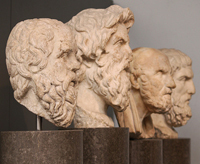
Busts of Greek philosophers from Socrates to Epicurus as seen in the British Museum, London. Photo by Lawrence OP.

Particularly enlivening to both the workshop’s presenters and participants is the nature of the dialogue they can expect at 91Թ. “You really could not do this anywhere else, given the astonishing range of disciplines we currently represent,” Reydams-Schils says.

In addition to this scholarly depth, she says, 91Թ also provides an academic arena that is hospitable to exploring religious and spiritual aspects of the western philosophical tradition that at another university might be downplayed or ignored.

A recent presenter who discussed the religious aspects of Socratic thought told Reydams-Schils he could not imagine that avenue of research being properly appreciated at many other places besides 91Թ.

“There is a real genuine interest in those spiritual aspects that are treated as marginal elsewhere,” she says.

This is evident as well in the workshop’s first post-doctoral fellow funded by an external grant. Wiebke-Marie Stock, who was awarded a two-year Feodor Lynen Research Fellowship from the , has a background in classics, philosophy, art history, and early Christianity. She is affiliated with the Institut für Philosophie of the Free University of Berlin and is currently on a Martin Buber Society fellowship at the Hebrew University in Jerusalem.

For her research project at 91Թ, Stock plans to work on images in late antique theories of the soul, including Christian views.

“This profile is an ideal fit for the workshop’s multi-disciplinary approach,” Reydams-Schils says.

Since 2002, the Workshop on Ancient Philosophy has co-organized seven conferences, hosted 69 speakers (including 23 from outside the United States), assisted in the development of 15 dissertations, provided mentoring for several hundred graduate students, inspired 10 major publications, and hosted four issues of Plato, the online journal of the International Plato Society.

The workshop has already hosted three lectures from visiting scholars this fall, with more planned throughout the 2011-12 academic year.

One recent event was a review last month of the meaning of method in Aristotle by James Lennox, a history and philosophy of science professor from the University of Pittsburgh. On Nov. 10, Victor Caston, professor of philosophy and classical studies at the University of Michigan, gave a presentation titled “Aristotle on Perceptual Content.”


Originally published by Kevin Clarke at on October 25, 2011.

]]>
Kevin Clarke
tag:news.nd.edu,2005:News/22132 2011-06-02T14:14:00-04:00 2021-09-03T20:52:35-04:00 Abandoned Irish island offers window to the past Ian Kuijt on Inishark

The last 24 human inhabitants of the island of Inishark off the coast of Galway, Ireland, departed together on October 20, 1960—a beautiful, sunny day which marked a solemn end to a steady decline that began in the mid 19th century.

That’s when a more robust population of 300 or so first began to drift away from Inishark—many sought a new life in America. By 1960, life on the island had become too remote, too hard, too dangerous, says , a professor in 91Թ’s . “They never had electricity,” he says. “They never had phones.”

On the Connemara mainland nearby, these modern marvels were finally becoming commonplace. For most of the Irish, life was changing rapidly, and the people on Inishark realized they were being left behind. During medical emergencies the islanders were often reduced to signaling for help with hillside bonfires, and in 1959, stormy weather cut them off from the mainland for more than a month. “But the final straw was just the lack of young people,” says Kuijt.

The life on Inishark could not go on.

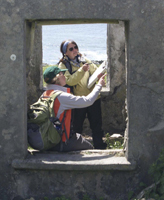
Elizabeth Elliott and Claire Brown on Inishark

This small community’s collapse more than 50 years ago now offers a unique opportunity to contemporary anthropologists like Kuijt—not just a freeze frame of island life in 1960 but “a window” to Irish life in the 19th century. “These people were living little differently than they were in the 1860s,” he explains.

Kuijt and his team of students, academics and technicians from 91Թ and Ireland are in a race to understand island life and capture the stories of the last 12 survivors of Inishark to preserve a portrait of their way of life before it disappears for good. The research is part of “Cultural Landscapes of the Irish Coast,” Kuijt’s six-year, multidisciplinary, inter-institutional study of coastal western Ireland.

Over the last four years, Kuijt and his team have made multiple field trips to Inishark, staying for up to 10 days at a time. They lug in enough equipment—computers, GPS, and video and audio gear—to quickly assemble a “rustic lab,” he says. Because of the site’s remoteness they must transport all their food and water.

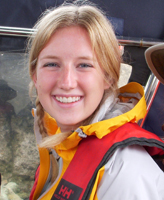
Claire Brown

91Թ anthropology student Claire Brown has roughed it on the island with Kuijt’s project for the past three summers and says the fieldwork has been one of the most compelling parts of her research experience.

“When we work on the island and survey the houses, I feel like I am seeing history come alive,” she says. “To be on the island and look at these houses that we have heard so much about during our interviews with the islanders is an incredible experience. It helps us understand history from a personal perspective.”

During these expeditions, students do a little bit of everything—from interviewing former island residents to constructing a detailed map of the village to participating in an archaeological excavation around abandoned houses.

Over the years Kuijt and his team have taken five of Inishark’s last inhabitants back to the island to tour the village and record their reminiscence. For the islanders and Kuijt’s students, the visits are profoundly bittersweet. The islanders are deeply moved to be back but heartbroken that this life could not go on. “Several of them tell me that when they dream,” says Kuijt, “they always dream that they are young children back on ‘Shark.’”

The survivors’ willingness to share their lives and commitment to getting the story told is all the encouragement Kuijt needs. He knows time is not on his side. “These are rich personal histories that help us to understand the past,” he says, stories the abandoned stone ruins of Inishark seem almost to tell. “If it doesn’t get written down now,” says Kuijt, “it will be lost forever.”

Like her professor, Brown says trying to capture the unique experience of the Inishark islanders has become more than just an anthropological challenge. “The project is certainly important in an academic sense but almost more so at the personal level,” she says. “We are in contact with those who lived on Shark who are still alive, and our research is very important to them. We are dealing with their histories and their lives, and they have been on the whole very appreciative of our efforts.”

This sense of mission has led Brown to continue working on aspects of the project beyond what is required for her coursework. “I feel a deep connection to the place and the people.”


Originally published by Kevin Clarke at on April 25, 2011.

]]>
Kevin Clarke
tag:news.nd.edu,2005:News/19231 2011-04-06T16:50:00-04:00 2021-09-03T21:01:53-04:00 91Թ anthropologist takes Irish oral tradition online Deb Rotman

Deb Rotman is in a race against time.

, director of undergraduate studies for 91Թ’s , is keenly aware that the generation of Irish immigrants who can still share memories of the Irish Civil War and their experiences in early 20th century America will soon be lost forever.

“Those generations have some really great stories that we’re trying to capture, but we can only do so much,” she says.

Unable to personally interview every surviving immigrant, Rotman and a group of her students are working with Kevin Abbott in the University’s office to construct an to help collect and preserve as many of these valuable tales as possible before it’s too late.

The database’s Web interface, intended to be user-friendly for casual visitors and professional researchers alike, will take advantage of the latest technology to offer an experience that is wholly contemporary yet distinctively Irish. “This is a storytelling people,” Rotman says, and the database will play to that strength and allow users to upload personal histories in whatever format they prefer.

Senior Rhiannon Duke is one of the students helping Rotman develop the online project, which will incorporate audio, text, photographs, and possibly video.

Rhiannon Duke

“It will be a place for those of Irish descent to share their stories and information with others and develop a dialogue of sorts,” she says. “A space to share these kinds of stories is incredibly important, and I’m excited that I’ve been able to be a part of it thus far. I can’t wait to see how it grows and develops in the future.”

In addition to soliciting oral histories online, Rotman and her students are making their own contributions to the database by conducting field research on Lake Michigan’s Beaver Island. There, a group of 19th century Irish—most from the island of Árainn Mhór off the coast of Donegal—recreated something of the communal, agrarian lifestyle they had left behind.

“Most of what the general public knows about Irish-American history comes from the stories of urban immigrant populations in places like New York, Boston, Chicago and Philadelphia,” Duke says.

In these cities, she says, the Irish lived among other large immigrant groups and families who had been in America for generations. “Beaver Island offers a unique chapter of the Irish-American story since the Irish were in the majority there for about 40 years,” Duke says. “It will be fascinating to see to what extent this community was able to transfer their social and cultural environment from Árainn Mhór to Beaver Island and how that environment changed through time.”

Much of the fieldwork involves meeting with descendants of the original Irish settlers there. “My favorite part of the experience was interviewing residents about their family history on the island as well as their personal experiences of island life and identity,” Duke says. “I had read a good amount about Beaver Island before arriving, but I learned so much more from speaking with residents than I could have in a book.”

While on Beaver Island, Rotman’s students also get their hands dirty in archaeological digs of old homesteads. They have uncovered rich material not just within the one-time walls of family homes, but outside them as well. “Think about it,” Rotman says, “in the 1860s you didn’t have waste management coming to your curb side.” Remnants of the refuse that collected behind homes now offers compelling clues about the way life was actually lived in 19th century immigrant America, she says.

By combining this traditional fieldwork with innovative technology, Rotman and her students hope to provide a broader perspective on the Irish diaspora in America.

“The archaeological record and the historic documents work together telling different parts of the same story,” she says, “and oral history is the third leg of that stool.”

Originally published by Kevin Clarke at on March 28, 2011.

]]>
Kevin Clarke