
The concept of wave interference has always interested scientists. Whether it is the interference of light, sound, water��or other kinds of waves, understanding the mechanics of these phenomena are important, but it can also be complicated, especially for electron density waves at the nanoscale.
Experimentalists from the University of 91勛圖 and theorists from the University of Washington have been trying to observe a specific type of interference, known as a Fano interference, for nearly 10 years. The interference is considered unique because it occurs when a quantum transition that is long-lived interacts with one that is not, producing a mixture of corresponding discrete and continuum configurations.��
Overall, the research team aimed to see this interference occur using electron microscopy ��� a technique for obtaining high-resolution images of nanoscopic specimens. Since the original concept for the Fano interference mechanism was developed in the 1960s in the context of helium vapors, the researchers theorized that today���s technology would make observing the phenomenon in other systems fairly simple.
���The question of, ���Could we see this Fano interference in electron microscopy?��� was much more complicated than we expected,��� said , professor of and director of undergraduate studies in chemistry and biochemistry at 91勛圖. ���Early on we realized the ideas our team came up with weren���t working. But eventually, through trial and error, we got it right.�����
In a paper published in , Camden and collaborators used a combination of electron energy-loss spectroscopy and theoretical modeling to witness the first direct detection of Fano resonances, or Fano interferences, in a pair of nanoscopic gold particles. The study constructed and measured Fano interferences in the spectral response of this system.��
To explain the research, , co-corresponding author on the paper and professor of chemistry from the University of Washington, said, ���Imagine a swing set with two swings that are weakly linked, except when you push one swing it doesn���t move, yet the second one does. This is an effect caused by interference, and it���s not intuitive, so it���s difficult to explain and replicate.�����
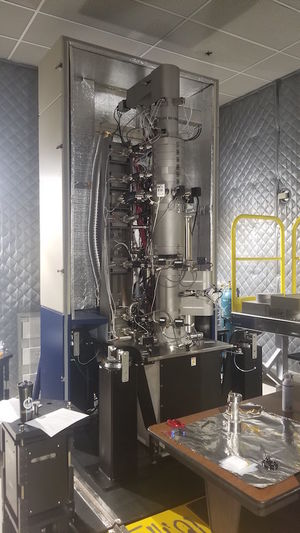 Microscope used at Oak Ridge National Laboratory
The team used a gold nanostructure that consisted of a small disk next to a long rod, both separated by only a few tens of nanometers. The observation was obtained by locating the nano-sized electron probe next to the gold disk in the opposite direction of the gold rod. The gold disk acted as an antenna, transmitting the energy of the electron probe to the rod. The energy oscillation of the disk and the rod interfere, resulting in intensity profiles with the asymmetric spectral signature that the research team had been looking for. �� �� ��
Although the experimental observation in the study is the same concept established by physicist Ugo Fano long ago, the researchers used a different physical system to observe the phenomenon at the nanoscale, which required major advancements in the field of electron microscopy. Those advancements have happened only recently. By collaborating with at Oak Ridge National Laboratory (ORNL) and at the University of Tennessee and ORNL, the research team was able to use one of ORNL���s advanced electron microscopes, which is one of a few microscopes in the world that could make this observation.
This research was funded by the U.S. Department of Energy. Certain experiments were conducted at the Center for Nanophase Materials Science at ORNL and also, in part, using instrumentation within ORNL���s Materials Characterization Core, provided by UT-Battelle��LLC. Additional authors on the paper from 91勛圖 are Agust Olafsson and Xuan Hu. Other collaborators are Kevin C. Smith and Steven C. Quillin��from the University of Washington, as well as Robyn Collette from the University of Tennessee. Camden is an affiliated member of , 泭硃紳餃 .
To read the study, which was selected as an Editor���s Suggested article, visit .
Contact: Brandi Wampler, communications specialist, 91勛圖 Research,��brandiwampler@nd.edu, 574-631-8183;�����������������������
Originally published by at on 捧棗措.泭7.